
AI Journal Review Needs Governance, Not Just Automation
Journal review is a useful place to apply AI, but only when the workflow makes evidence, uncertainty, and approval visible.
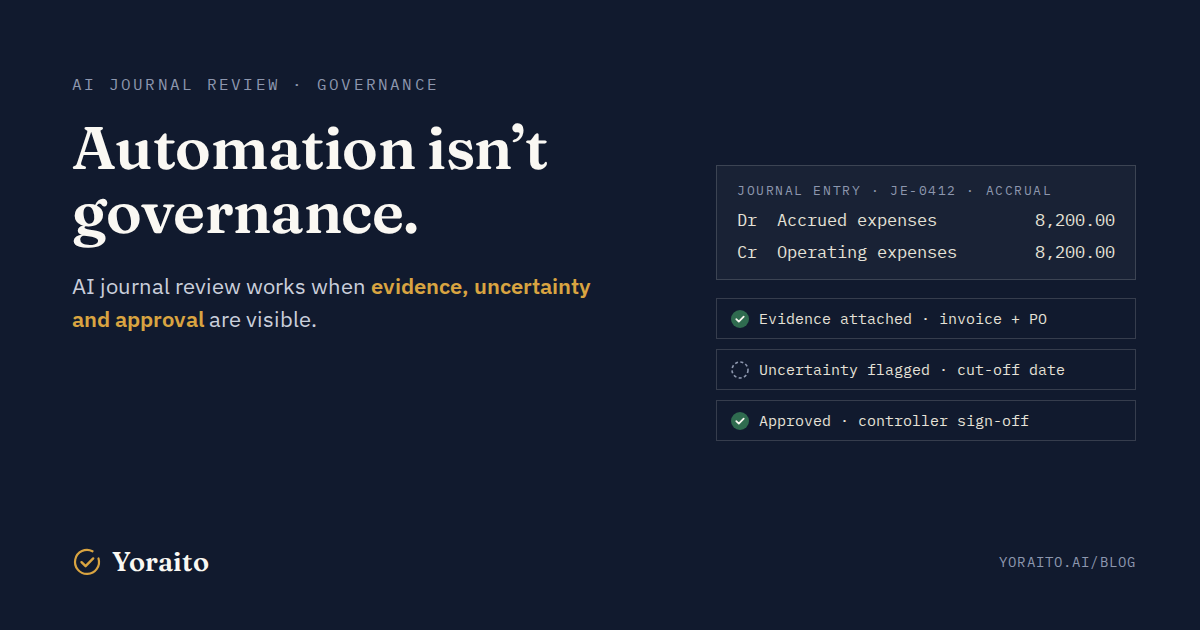
AI journal review is moving from an interesting demonstration to a practical question for finance teams. Recent accounting technology coverage has highlighted governed workflow agents and AI-assisted journal review. The opportunity is real, but the useful question is not whether a model can describe a journal entry.
The useful question is whether the review process makes a qualified person more effective without making the accounting judgment less visible.
Journal review is a control activity
A journal entry is not just a row to classify. It is part of a period close, supported by documentation, connected to accounts and reporting objectives, and reviewed in the context of materiality and policy. An AI system may help collect evidence, identify unusual patterns, or compare a proposed entry with prior activity. It should not erase the context that makes the review meaningful.
Six questions for evaluating AI journal review
1. What exactly is being reviewed?
A review screen should identify the entry, period, accounts, amount, preparer, source support, and reason for the review. A score without the underlying record is not a control. The reviewer needs enough context to understand whether the entry is ordinary, unusual, incomplete, or outside policy.
2. Can the system show its evidence?
If a system flags an entry because it differs from historical activity, the reviewer should be able to see the comparison. If it suggests an account, the reviewer should see the relevant rule or evidence. The language used by the model is secondary to the evidence that supports the recommendation.
3. What happens when the evidence is incomplete?
The correct behavior is to identify the gap. Missing support, an unexpected account, an unexplained amount, or conflicting source data should create a clear exception. The system should not convert a missing document into a confident narrative.
4. Who owns the approval?
The reviewer, not the model, owns the approval decision. The application should make that distinction visible. A generated recommendation can be useful. A generated signature is not a substitute for authorization.
5. Is the review decision recorded?
A useful audit trail records the original proposal, supporting evidence, reviewer, decision, time, and any change made. It should also preserve the reason for an override. This matters when a reviewer has to explain a decision months later.
6. Can the team start narrowly?
Journal review should be introduced in a controlled scope. A team might begin with recurring accruals, a single entity, or a defined review population. Narrow scope makes it easier to compare the system with existing review work and identify where the process needs refinement.
Governance is part of the product, not a policy document
Governance is often described as a set of rules around an AI system. For journal review, governance must also be present in the workflow itself. The reviewer should see the boundary of the system, the reason a recommendation was made, the evidence available, and the action that remains theirs to take.
This is why a governed workflow is different from a chatbot attached to the general ledger. A chatbot can produce a plausible explanation. A governed review flow coordinates data, evidence, exceptions, and approval.
A practical operating model
A controller evaluating the workflow can ask the team to walk through four cases: a routine entry, an unusual but valid entry, an entry with missing support, and an entry that should be rejected. The quality of the system is visible in how it handles all four, not just the routine case.
For each case, ask to see the input, recommendation, evidence, exception state, reviewer action, and final record. Ask whether the same case would produce the same recommendation when the inputs have not changed. Ask how changes to the model, rule set, or source data are identified.
The benefit is better review, not less accountability
The best use of AI in journal review should reduce search and preparation effort while preserving accounting judgment. It can help a reviewer focus attention on entries that deserve it. It can gather related records. It can identify patterns that are difficult to spot manually. But it should make the review more defensible, not make responsibility harder to locate.
That distinction matters for CFOs, controllers, auditors, and CPA firms. The value is not a system that says yes to more entries. The value is a system that helps the right person reach a better-supported decision.
Source: Accounting Today technology coverage, September 18, 2026. https://www.accountingtoday.com/technology