
Jev for Accounting: Ten Places a Typed Decision Model Could Fit
Jev has drawn attention because it returns typed decisions instead of generated prose. Here are ten accounting use cases where that distinction could matter, and where human review still belongs.
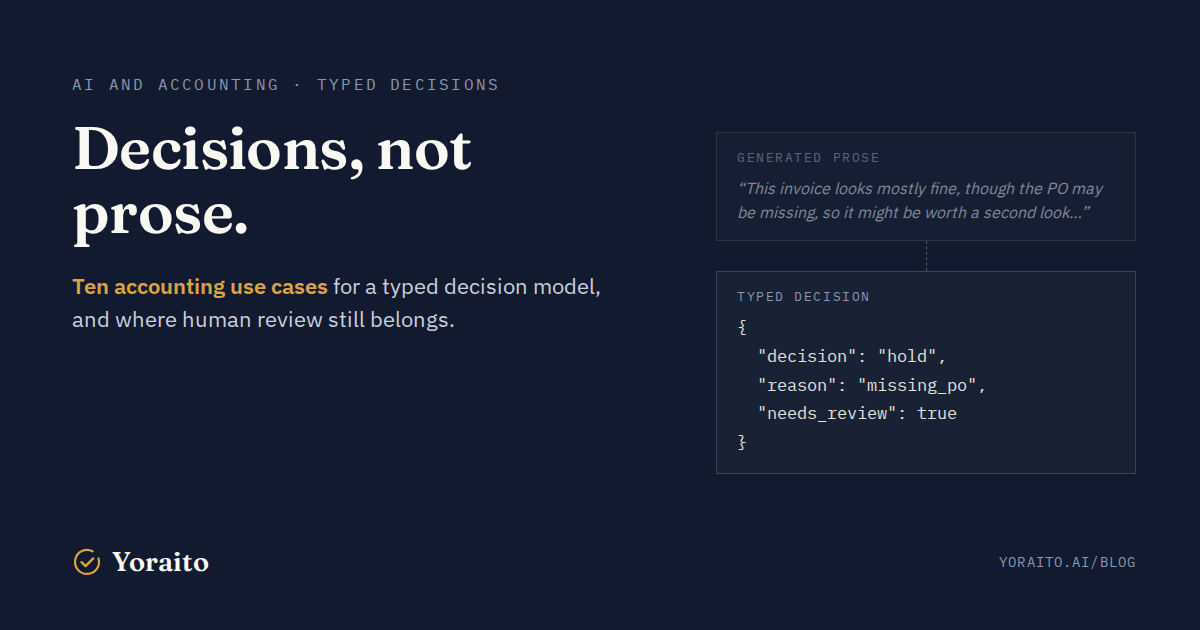
Jev has attracted attention because it takes a different approach to AI output. Instead of asking a model to produce a paragraph, a summary, or a conversational answer, Jev is designed around typed decisions and calibrated probabilities. That makes it an interesting development for accounting, where many workflows end in a bounded decision rather than a piece of prose.
The accounting question is not whether Jev replaces a controller or an auditor. It does not. The useful question is where a typed decision model could reduce repetitive review while keeping the evidence, uncertainty, and human approval visible.
What makes Jev relevant to accounting
Many accounting workflows contain a classification or routing step. Is this transaction a match? Does this invoice belong to this vendor? Is this journal entry unusual? Does this document support the proposed account? These decisions can be represented as a finite set of outcomes, provided the input data and decision policy are defined.
A typed output can also make downstream handling clearer. A result can be accepted, rejected, sent for review, or marked as insufficient evidence. That is different from receiving a natural-language answer that a person still has to interpret and translate into a workflow action.
Ten accounting use cases
1. Bank reconciliation match decisions
A decision model could classify a bank transaction and ledger entry as match, possible match, or no match. The decision should use amount, date, reference, counterparty, and account context. A possible match should remain an exception until a reviewer confirms it.
2. Invoice and purchase order matching
For accounts payable, the output could classify an invoice as a clean match, quantity variance, price variance, missing purchase order, or manual review. The classification can route the invoice to the right queue without pretending that a confidence score is an approval.
3. General ledger account classification
Transactions often need to be assigned to an account, department, entity, or cost center. A typed model could return the proposed class, confidence, and review status. The mapping should remain tied to the chart of accounts and the evidence used for the decision.
4. Journal entry review routing
A journal entry can be routed as routine, unusual, incomplete, or high-priority review. Useful inputs might include amount, account combination, preparer, period, recurring pattern, and supporting documentation. The output should identify why the entry was routed, not simply label it high risk.
5. Duplicate transaction detection
A model could classify records as duplicate, likely duplicate, related but valid, or distinct. This is useful for invoices, payments, expense reports, and imported transactions. A reviewer still needs access to the records that caused the duplicate signal.
6. Vendor and customer normalization
A decision model could map a source name to an existing master record, create a new-record candidate, or route the item for review. This can reduce duplicate vendor records without automatically changing the master data.
7. Accrual support classification
For recurring accruals, a model could classify supporting evidence as sufficient, incomplete, inconsistent, or absent. It could also route items based on materiality. It should not decide that an unsupported accrual is correct merely because a similar entry existed last month.
8. Close checklist exception routing
A close task can be classified as complete, blocked, awaiting evidence, awaiting approval, or overdue. Typed states make it easier to coordinate work across a close without turning the system into an unreviewable autonomous operator.
9. Variance investigation triage
Variance work often begins with triage. A model could classify a variance as timing, volume, price, mapping, intercompany, or unexplained. The classification should point to the supporting comparison and leave the explanation and conclusion to the finance team.
10. Document evidence routing
A document can be classified as relevant support, irrelevant, incomplete, unreadable, or requiring a human decision. This is useful for close packs, invoices, contracts, and bank statements. The classification should retain the original document and the reason for the route.
Where the model should stop
Typed decisions can make a workflow more reliable, but they do not remove the need for accounting judgment. A model should stop when the evidence is incomplete, when the available classes do not describe the case, when the confidence is below the operating threshold, or when the decision would create a material accounting consequence without review.
That refusal path is not a failure. It is part of the control design. A controller needs to know which work can move automatically and which work needs attention.
The accounting opportunity
The most interesting possibility is not replacing the close team with a decision model. It is creating a clearer operating layer between raw finance data and human review. Typed decisions can route work, make uncertainty visible, and help systems behave predictably when the answer is not clear.
For CFOs and controllers, the adoption test is straightforward. Can the system show what it saw? Can it explain the class of decision? Can it stop? Can a reviewer correct it? Is the correction recorded? Can the same case be tested again?
Those questions matter more than a benchmark headline. They are the difference between an AI feature and a finance workflow that a team can responsibly operate.
Sources: TypeSafe AI announcement and public Jev coverage dated September 15 to 19, 2026. https://www.explainx.ai/blog/jev-speed-cost-claims-fact-check-2026