
AI in Finance Statistics 2026: The State of Trust
AI in finance statistics for 2026 from 10 surveys: use is broad, but trust, governance and proof lag behind. Every number sourced, with sample sizes.
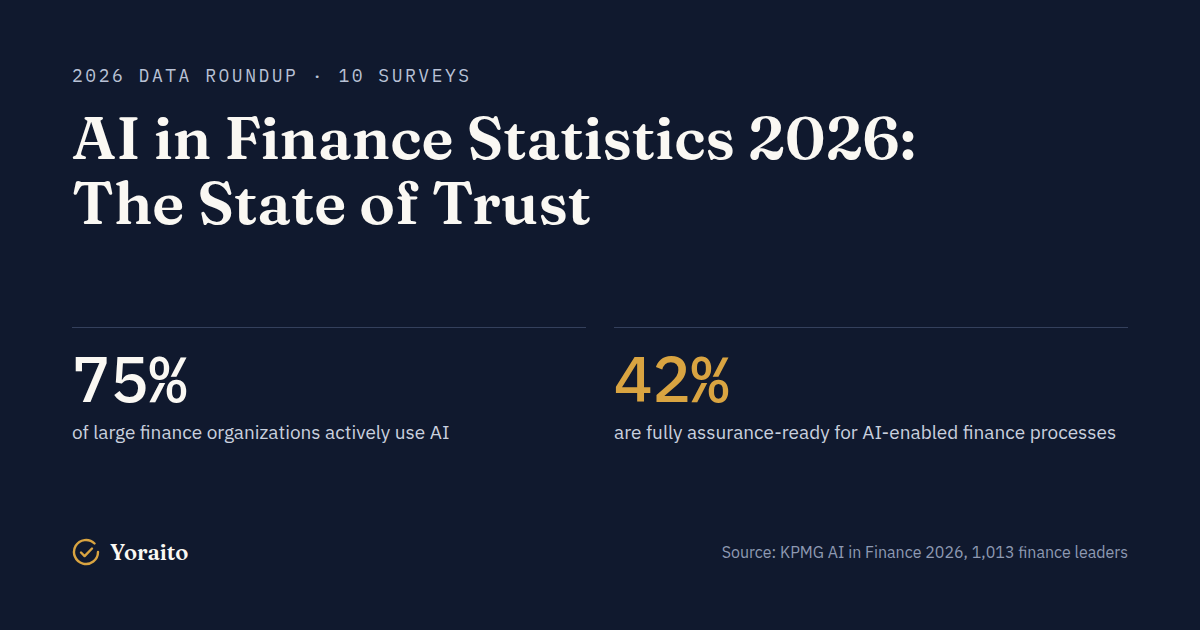
Most finance teams now use AI. Far fewer let it act on its own, and fewer still can show an auditor what it did.
We pulled the 2026 AI in finance statistics from 10 surveys, published between November 2025 and September 2026, and grouped them by the question a controller would ask: do teams use it, trust it, govern it, and can they prove it works? Every number links to its source, with who ran the survey and how many people answered.
TL;DR: In 2026, AI use in finance is broad: 75% of large finance organizations use it actively (KPMG). Trust is not. Only 14% of mid-market CFOs completely trust AI to deliver accurate accounting data on its own, and 86% have seen it produce wrong data (Maximor). Just 42% are fully assurance-ready (KPMG). Use is ahead of proof.
What are the key AI in finance statistics for 2026?
- 75% of finance organizations with $250M+ in revenue actively use AI, up from 30% in 2024. (KPMG, 1,013 leaders)
- 42% of those finance organizations are fully assurance-ready for AI-enabled finance processes. (KPMG)
- 29% track where AI adoption fails. (KPMG)
- 14% of mid-market CFOs completely trust AI to deliver accurate accounting data independently. (Maximor / Wakefield Research via CFO Dive, 100 CFOs)
- 86% of those CFOs say their team has hit inaccurate or hallucinated data while using AI. (same study)
- 28% of finance and operations leaders are comfortable letting AI make routine financial decisions. (PEX via CFO Dive, 687 leaders)
- 29% of finance leaders let AI act with human approval; 32% use it only to recommend actions people carry out. (Esker, 338 leaders)
- 43% of large-company CFOs point to insufficient visibility into AI tools or use. (Deloitte, 200 CFOs)
- Nearly 90% of public-company audit partners call AI governance at their largest client "developing" or "early stage." (CAQ)
- 21.0% of finance organizations report meaningful, measurable results from AI. (Auditoria.AI, about 300 respondents)
These surveys asked different people different questions. Read each number against its own sample, not against the others.
How widely do finance teams use AI in 2026?
Widely, and the answer depends on company size. Gartner's 2025 survey of 183 finance leaders found 59% using AI in their finance function, almost flat from 58% in 2024. Among larger organizations the numbers run higher. KPMG puts active use at 75% for companies with at least $250M in revenue ($500M in the US). Deloitte's Q2 2026 CFO Signals survey of 200 North American CFOs at $1B+ companies found 93% use AI across key operations.
"Use" is doing a lot of work in those figures. Using AI somewhere in the business is not the same as running it at scale in the close. In Oliver Wyman and NYSE's CFO survey of about 500 CFOs, only 8% said they had deployed AI at scale. Auditoria.AI's September 2026 survey found 58.4% of finance teams still exploring or piloting.
Adoption in 2026 is broad but shallow: most finance teams use AI somewhere, and few run it at scale.
How much do finance leaders trust AI to act on its own?
Not much. This is the clearest pattern across the data.
- Completely trust AI to deliver accurate accounting data independently
- Share: 14%
- Survey (sample): Maximor / Wakefield (100 mid-market CFOs)
- Comfortable letting AI make routine financial decisions
- Share: 28%
- Survey (sample): PEX (687 finance and ops leaders)
- Let AI act, with human approval
- Share: 29%
- Survey (sample): Esker (338 finance leaders)
- Use AI only to recommend; people carry out the action
- Share: 32%
- Survey (sample): Esker (338 finance leaders)
- Say human oversight is critical for accurate data
- Share: 97%
- Survey (sample): Maximor / Wakefield (100 mid-market CFOs)
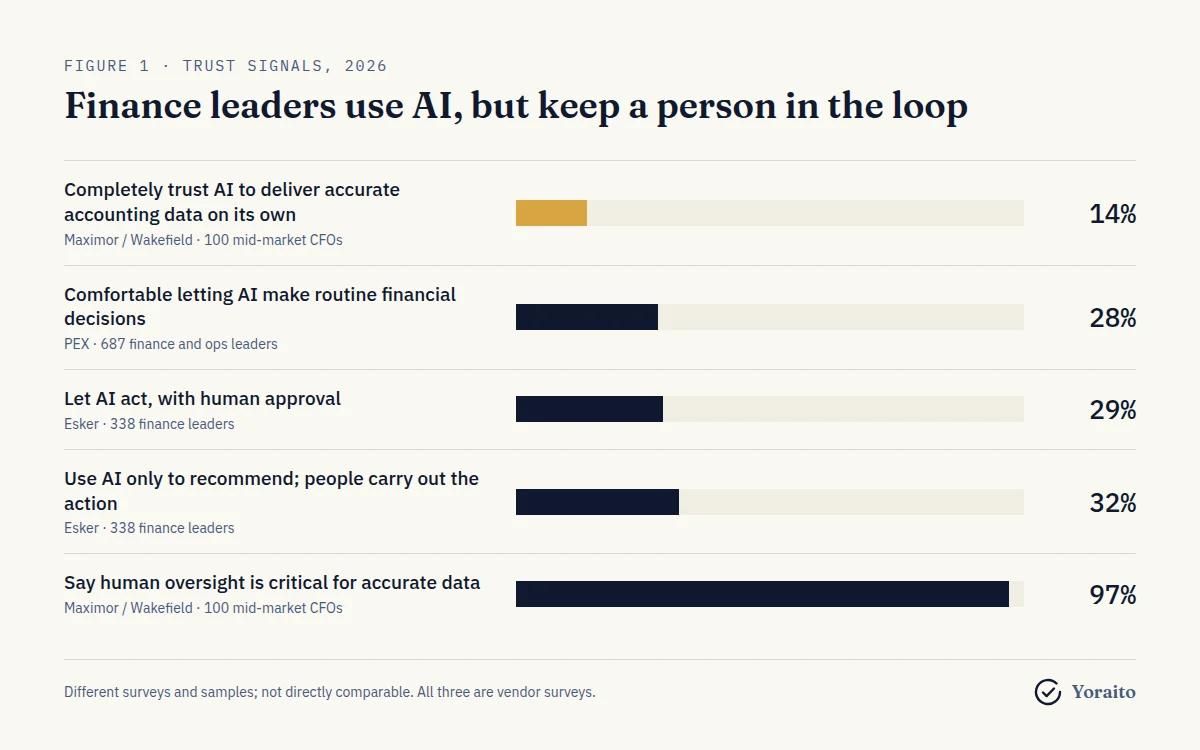
Figure 1. How far finance leaders let AI go. Sources: Maximor/Wakefield, PEX, Esker (2026). Different surveys; not directly comparable.
The finance leaders in these surveys are not refusing AI. They are keeping a person between the AI and the ledger. That makes the reviewer's job the real bottleneck, which we covered in why AI spend isn't turning into ROI.
Why don't finance leaders trust AI output?
Because they have seen it be wrong. In the Maximor study, 86% of CFOs said their team had hit at least one instance of inaccurate or hallucinated data from AI. In the PEX survey, 36% named the accuracy of AI output as the top barrier to wider use. Esker found 48% cite data quality as a barrier to expanding AI's role, and KPMG found 36% name data quality as both a barrier and an opportunity.
Two problems are mixed together here. One is the AI getting an answer wrong. The other is bad data going in. A reviewer can't tell them apart unless the output shows which rows it used and which rule it applied.
In 2026 surveys, the leading reason finance teams hold AI back is accuracy, and it starts with the data AI is fed.
Is AI governance in finance keeping up?
Mostly no, and CFOs and auditors describe it differently.
Deloitte's CFOs sound confident: 96% are somewhat or very confident in their company's AI governance framework. In the same survey, 59% say their top challenge is balancing pressure to deploy AI quickly with managing risk, 51% report a lack of governance authority, and 43% point to insufficient visibility into AI tools or use.
Auditors are less confident. In the Center for Audit Quality's 2026 Spring Audit Partner Pulse Survey, nearly 90% of audit partners described the maturity of AI governance at their largest client as "developing" or "early stage."
Two more numbers show where the gaps are. Esker found 66% of finance leaders know or suspect employees are using unapproved AI tools. KPMG found only 29% track where AI adoption fails.
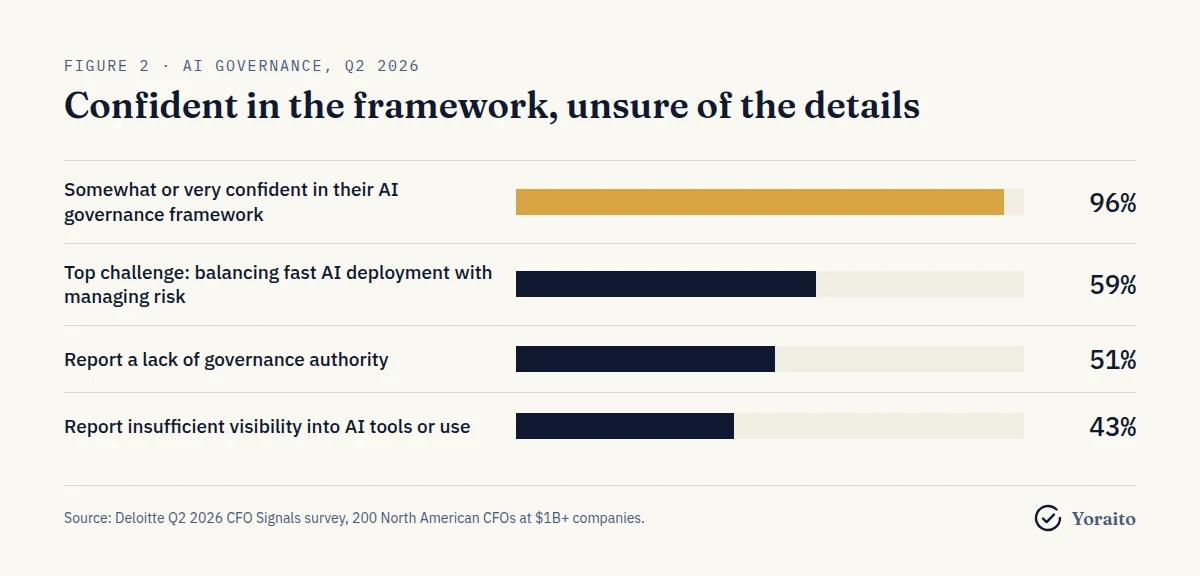
Figure 2. Confident in the framework, unsure of the details. Source: Deloitte Q2 2026 CFO Signals (200 CFOs, $1B+ revenue).
Governance is the widest trust gap in 2026: CFOs rate their frameworks highly, while audit partners call most of them early stage.
Are finance teams seeing results they can prove?
Some are. The data splits sharply on who.
KPMG reports that 71% of finance organizations are meeting or exceeding ROI expectations on AI. Auditoria.AI found only 21.0% reporting meaningful, measurable results, with 66.5% increasing AI investment. Esker found 72% spent more than planned on AI over the past year. The samples differ in size and company profile, so the gap between 71% and 21.0% is not a contradiction to resolve. It is a sign that "results" means different things to different respondents.
The most useful number for a controller is KPMG's split by assurance readiness. KPMG describes assurance-ready organizations as those "able to produce audit evidence and explain it." Only 42% are fully assurance-ready. Those organizations reported error reduction at 33%, against 6% for their peers, and 42% were confident scaling AI, against 14%.
KPMG's survey shows a correlation, not a cause. Still, it is the one data point in this set that links proof directly to results.
In KPMG's 2026 survey, finance teams able to produce and explain audit evidence for AI reported far higher error reduction: 33% versus 6%.
Gartner adds a note on what teams aim for: in a March 2026 survey of 204 finance leaders, 45% said their AI investments lean toward productivity and 20% toward decision quality.
What does this data mean for a finance team evaluating AI?
Our reading, not a finding from any one survey: the market has moved past "should we use AI?" The open question is whether a reviewer, and later an auditor, can check what it did. Before you expand AI's role in the close, check that you can answer yes to each of these:
- We can list every AI tool touching finance data, including ones teams adopted on their own
- Each AI output links to the source rows it used
- We can name the rule or logic behind an output, and its version
- Rerunning last month on the same data gives the same result
- Exceptions go to a named owner, not a silent fallback
- Reviewer sign-offs are tied to the items reviewed, not only the summary
- We record where AI got it wrong, so we can see where it fails
- Our auditor has seen the evidence and knows what they will test
If you can't tick the last box, start there. The questions an auditor will ask about AI matching are in what auditors ask about AI reconciliation.
Where does this data come from?
Four of the ten surveys were run by finance software vendors. Five come from research, audit and consulting firms that also sell AI advisory work. Only the CAQ survey comes from a nonprofit. That doesn't make the numbers wrong, but it is a reason to read them as signals, not benchmarks.
- Finance AI adoption survey
- Published: Nov 2025
- Run by: Gartner
- Type: Research and advisory
- Who answered: 183 CFOs and senior finance leaders
- Finance AI trust study
- Published: Jan 2026
- Run by: Wakefield Research for Maximor
- Type: Finance AI vendor
- Who answered: 100 US mid-market CFOs
- CFO survey on AI and finance teams
- Published: Apr 2026
- Run by: Oliver Wyman and NYSE
- Type: Consulting firm and exchange
- Who answered: About 500 CFOs
- AI in Finance 2026
- Published: May 2026
- Run by: KPMG
- Type: Audit and advisory
- Who answered: 1,013 finance leaders, 20 countries, $250M+ revenue
- Spring Audit Partner Pulse Survey
- Published: Jul 2026
- Run by: Center for Audit Quality
- Type: Audit profession nonprofit
- Who answered: Public company audit partners (sample size not published)
- Finance AI investment survey
- Published: Jul 2026
- Run by: Gartner
- Type: Research and advisory
- Who answered: 204 finance leaders
- Q2 2026 CFO Signals
- Published: Jul 2026
- Run by: Deloitte
- Type: Audit and advisory
- Who answered: 200 North American CFOs, $1B+ revenue
- State of Finance benchmark
- Published: Sep 2026
- Run by: PEX
- Type: Spend management vendor
- Who answered: 687 finance and operations leaders
- State of AI Automation in the Finance Office
- Published: Sep 2026
- Run by: Auditoria.AI
- Type: Finance AI vendor
- Who answered: About 300 finance, accounting and technology staff
- 2026 Global Finance AI Trust Index
- Published: Sep 2026
- Run by: Esker
- Type: Finance automation vendor
- Who answered: 338 finance leaders in the US, UK, EU, Australia and Canada
Figures are reported from press releases and news coverage, checked on September 25, 2026. We update this page each quarter. Download the full table as a CSV.
Where does Yoraito fit?
Yoraito is SQL-first AI for finance teams. Each automated step, such as a reconciliation match or a compliance check, is SQL your team and your auditor can read and rerun, and reviewer approvals are recorded against the items they cover.
Frequently asked questions
What percentage of finance teams use AI in 2026?
It depends on company size. Gartner found 59% of finance leaders using AI in their finance function in 2025. KPMG found 75% active use among organizations with $250M+ in revenue in 2026, and Deloitte found 93% of $1B+ companies use AI across key operations. Only 8% of CFOs in an Oliver Wyman and NYSE survey had deployed AI at scale.
Do CFOs trust AI in finance?
Mostly with a person in the loop. In a Wakefield Research study for Maximor, 14% of mid-market CFOs completely trust AI to deliver accurate accounting data on its own, and 97% say human oversight is critical. PEX found 28% of finance leaders are comfortable letting AI make routine financial decisions.
What is the biggest barrier to AI in finance?
Accuracy and data quality. In the PEX survey, 36% named the accuracy of AI output as the top barrier. Esker found 48% cite data quality, and 86% of CFOs in the Maximor study had seen AI produce inaccurate or hallucinated data.
How reliable are AI in finance statistics?
Treat them as directional. Four of the ten surveys here were run by finance software vendors and five by firms that sell AI advisory work. Samples range from 100 to 1,013 respondents. They ask different questions of different people, so compare each number with its own sample, not with other surveys.
How to cite this page
You're welcome to use these numbers. Please cite the original survey for each figure, and link to this page as the compilation: "Yoraito, AI in Finance Statistics 2026: The State of Trust, updated September 2026."