
Why Finance Teams Are Still Wary of Giving AI Control
Finance leaders do not need another argument for AI. They need a clear answer to a harder question: what happens when the system is uncertain?
A recent CFO Dive report said that only 28% of finance teams were comfortable allowing AI to make routine finance decisions. That number should not be read as resistance to technology. It is a signal that finance leaders are asking a more serious question than whether AI can produce an answer.
The question is whether the answer can be reviewed, challenged, reproduced, and owned by a person who is accountable for the close.
The problem is not automation. It is invisible judgment.
Finance teams automate work every day. Rules move transactions into accounts. Bank feeds reduce manual downloads. Reconciliation software identifies likely matches. Close management tools coordinate owners and deadlines. None of that is inherently controversial because the control path is familiar.
The concern rises when a system makes a judgment that cannot be explained in operational terms. A controller needs to know which records were considered, which rule or instruction was applied, what confidence existed, and what happened when the evidence was incomplete. A fluent explanation generated after the fact is not the same thing as an audit trail.
Five controls make AI easier to trust
1. A defined input boundary
The system should make clear what data it is using. That includes the source system, reporting period, account scope, transaction population, and any exclusions. If a reviewer cannot identify the input boundary, the output cannot be properly challenged.
2. Deterministic work where the rule is known
Not every accounting task needs a language model. Matching, aggregation, validation, and threshold checks are often better expressed as explicit rules or queries. The same input should produce the same result. If a model is used, the boundary should be visible rather than presented as a universal substitute for accounting logic.
3. A refusal path
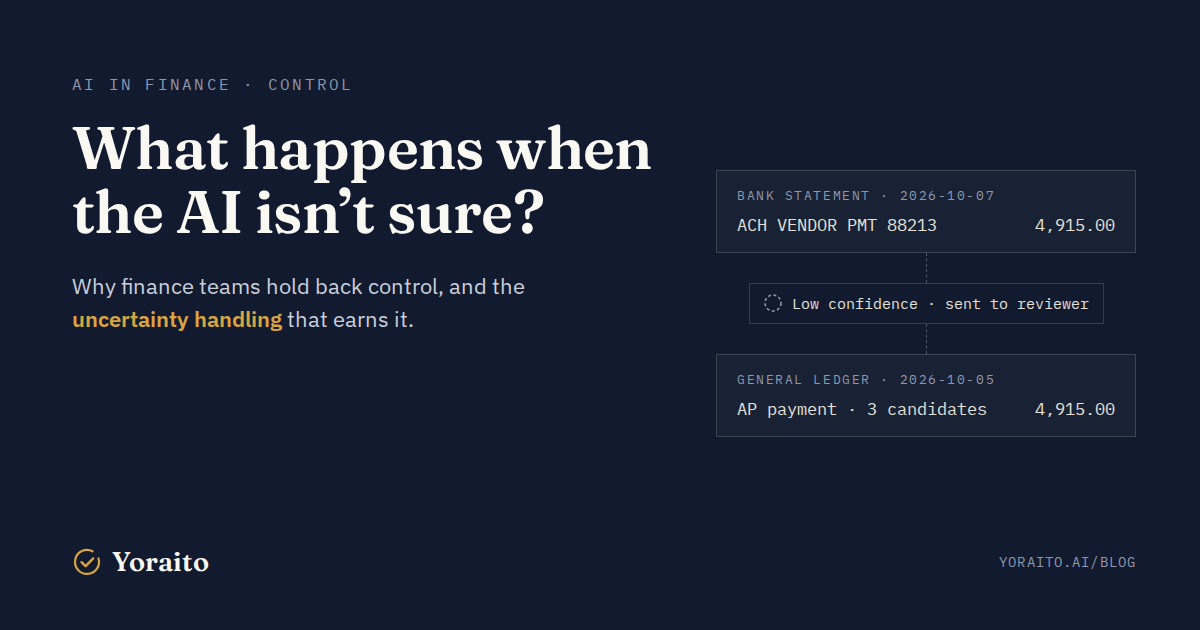
The safest system is not the one that always completes a task. It is the one that knows when to stop. Low confidence, conflicting records, missing support, and unexpected values should create a labelled exception. A controller can work with an exception. A silent guess is much harder to find.
4. Human ownership at the point of consequence
Human review should not be a decorative approval button at the end of an opaque process. The reviewer needs to see the proposed result, supporting evidence, exception reason, and available action. The person approving the close should be able to understand what they are approving.
5. A record that survives the conversation
When an auditor, CFO, sponsor, or successor asks how a number was produced, the answer should not depend on someone remembering what happened. The system should preserve the relevant source, execution context, result, exception status, and approval history.
What this means for a CFO evaluating an AI vendor
Ask the vendor to demonstrate a failure, not only a successful workflow. What happens when two records appear to match but the amounts disagree? What happens when a source column changes? Can the system show the population it considered? Can a reviewer override a result, and is that decision recorded?
Also ask which parts of the workflow are deterministic and which parts depend on a model. Ask how model changes are handled. Ask how the vendor separates customer data. Ask which service providers receive data and how long operational records remain available.
The adoption path can be deliberately narrow
Finance teams do not need to hand over the entire close to begin learning. A sensible first step can be a read-only workflow, a single reconciliation population, a reporting preparation task, or an exception review queue. The goal is to compare system output with existing practice while preserving the current approval process.
That approach gives the finance team evidence before expansion. It also gives the vendor a chance to show whether its controls work under ordinary pressure, not just in a prepared demonstration.
The standard should be confidence with a reason
The 28% figure is useful because it reflects the real posture of finance teams. They are curious about AI and cautious about invisible control. That is a healthy starting point. The answer is not louder automation messaging. It is better evidence.
For AI to earn a place in the close, it must make its work easier to inspect, not harder. It should execute within a defined boundary, stop when the evidence is weak, and leave the final decision with the person accountable for the number.
Source: CFO Dive, Finance teams still wary of giving AI control, September 17, 2026. https://www.cfodive.com/news/finance-teams-still-wary-giving-ai-control-pex/830091/