
AI Accounting Pilot: A 30-Day Scorecard for Finance Teams
A 30-day AI accounting pilot scorecard: six measures, a week-by-week plan, pass criteria to set before day one, and SQL your team can rerun to score it.
Most AI accounting pilots end with a good demo and no decision, because nobody wrote down what "worked" would mean before day one. This scorecard fixes that: six measures, a four-week plan and a pass or stop call you can defend to your CFO and your auditor.
TL;DR: A 30-day AI accounting pilot should test one process against a month where you already know the right answers. Score six measures: accuracy against that answer key, exception rate, false accepts, reviewer minutes per item, traceability and replay. Set every target before day one, run the tool in parallel with your current process, then expand, extend or stop.
Why do so many AI accounting pilots stall?
Plenty of finance teams are running pilots. Far fewer can say what those pilots proved. In Auditoria.AI's 2026 vendor survey of about 300 finance and technology respondents, 58.4% of finance teams were still in the exploring or piloting stage, and only 21.0% reported meaningful, measurable results.
Measurement is part of the problem. KPMG's March 2026 survey of 1,013 senior finance leaders found that only 29% track where AI adoption fails. If you don't count failures during a pilot, you can't tell a tool that is nearly always right from one that is often right, and in a bank rec that gap is the whole job.
Trust is the other part. In a PEX survey of 687 finance and operations leaders, 36% named trust in accuracy as the top barrier to AI adoption (more on that survey in why finance teams are still wary of giving AI control). A pilot is where that trust is earned or lost, so it should produce evidence, not impressions.
An AI accounting pilot is a time-boxed test of one AI tool on one finance process, scored against targets you set in advance, to decide whether to expand, extend or stop.
What should an AI accounting pilot scorecard measure?
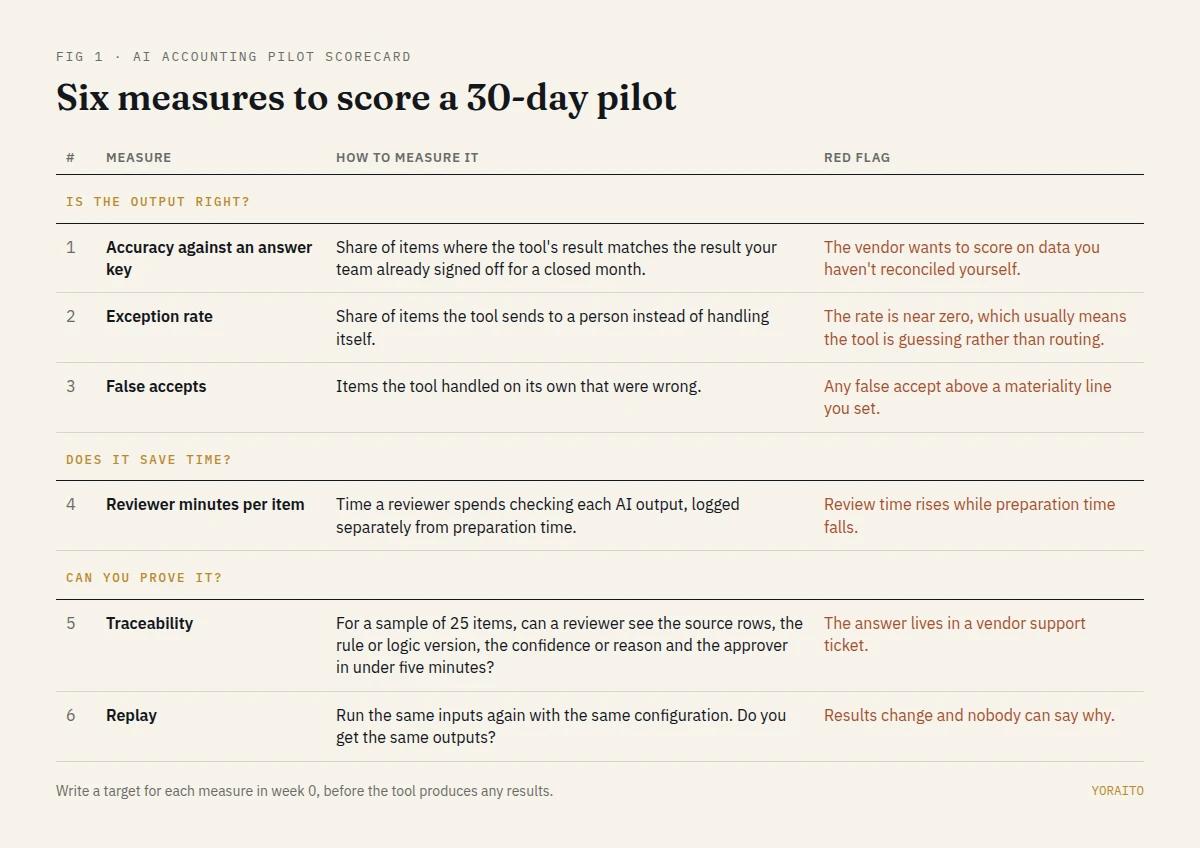
Six measures cover what a controller and an auditor will ask. The first three test whether the output is right. The fourth tests whether it saves time. The last two test whether you can prove it.
- 1. Accuracy against an answer key: Share of items where the tool's result matches the result your team already signed off for a closed month. Red flag: the vendor wants to score on data you haven't reconciled yourself.
- 2. Exception rate: Share of items the tool sends to a person instead of handling itself. Red flag: the rate is near zero, which usually means the tool is guessing rather than routing.
- 3. False accepts: Items the tool handled on its own that were wrong. Red flag: any false accept above a materiality line you set.
- 4. Reviewer minutes per item: Time a reviewer spends checking each AI output, logged separately from preparation time. Red flag: review time rises while preparation time falls.
- 5. Traceability: For a sample of 25 items, can a reviewer see the source rows, the rule or logic version, the confidence or reason and the approver in under five minutes? Red flag: the answer lives in a vendor support ticket.
- 6. Replay: Run the same inputs again with the same configuration. Do you get the same outputs? Red flag: results change and nobody can say why.
False accepts matter more than headline accuracy. A tool that flags the items it is unsure about is safer than a slightly more accurate one that hides its misses.
Measure 4 is the one most business cases skip. If your reviewer re-checks every item because they can't see how it was produced, the hours move from preparation to review and the saving disappears. PEX found that among the 340 respondents already piloting or using AI, 69% said they had cut their time for manual review. Your pilot should tell you which side of that line you are on.
How do you set pass criteria before day one?
Write the targets down, get your CFO to agree, and don't change them mid-pilot. The right numbers depend on the process and your risk appetite, so here are the decisions rather than universal thresholds:
- Pick one process and one scope: for example, bank reconciliation for your two main operating accounts, or AP invoice coding for your top 50 vendors.
- Freeze an answer key: a closed month your team already reconciled and reviewed. This is what accuracy is measured against.
- Set a materiality line for false accepts: the dollar amount above which a single wrong auto-handled item fails the pilot.
- Set a target for reviewer minutes per item, based on a two-week time sample of your current process.
- Name one owner on your side, and agree on what the vendor does and what your team does.
- Write the stop rule: the result that ends the pilot early, such as a false accept above your line in week one.
Setting targets after you see results turns a pilot into a demo.
What does a 30-day pilot plan look like?
Thirty days covers one month-end close plus a parallel run, which is enough to see real exceptions. Some practitioners recommend a longer window: Glenn Hopper's framework, published by Zone & Co, asks for a KPI that moves within 90 days. If your process only runs quarterly, extend to cover one full cycle.
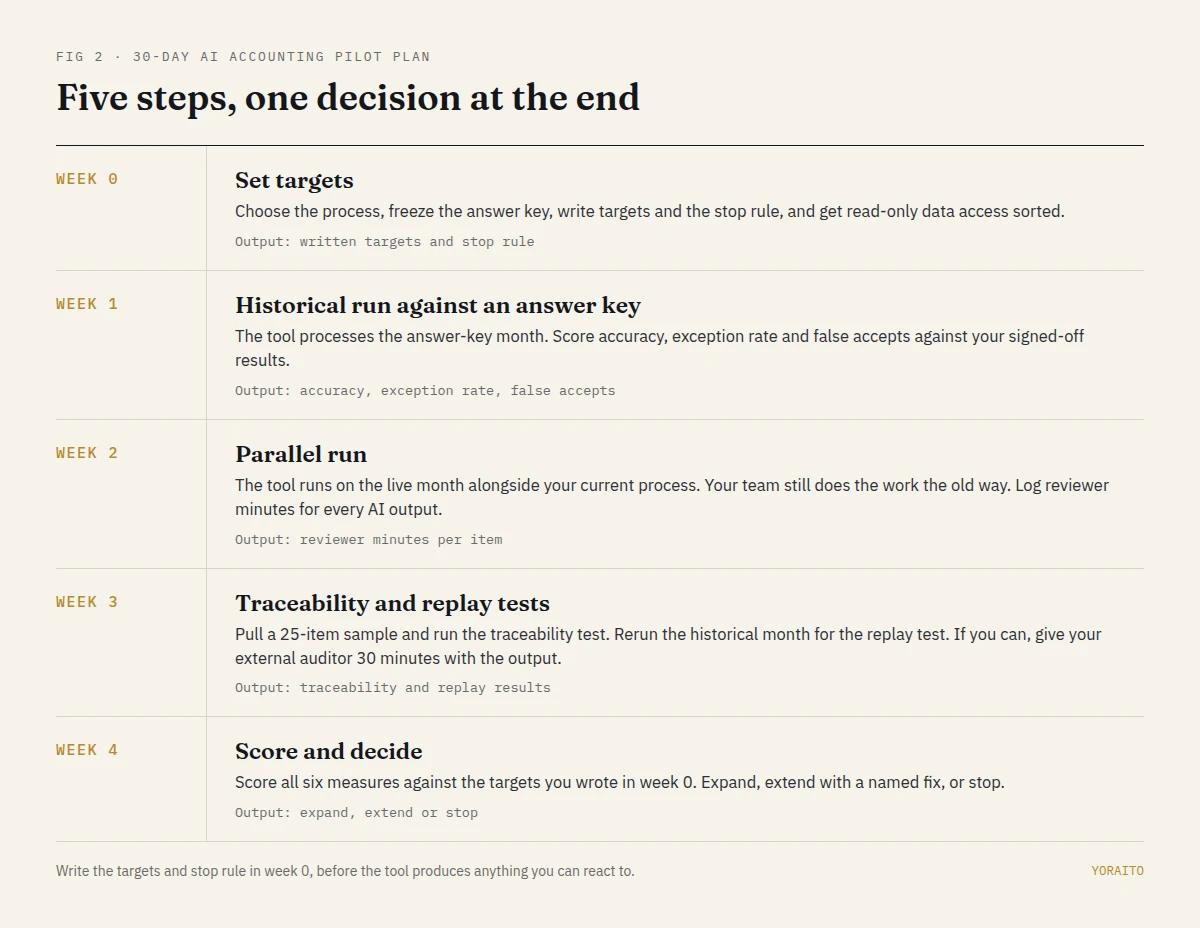
- Week 0 (before day one): Choose the process, freeze the answer key, write targets and the stop rule, and get read-only data access sorted.
- Week 1, historical run: The tool processes the answer-key month. Score accuracy, exception rate and false accepts against your signed-off results.
- Week 2, parallel run: The tool runs on the live month alongside your current process. Your team still does the work the old way. Log reviewer minutes for every AI output.
- Week 3, evidence tests: Pull a 25-item sample and run the traceability test. Rerun the historical month for the replay test. If you can, give your external auditor 30 minutes with the output.
- Week 4, decide: Score all six measures against the targets you wrote in week 0. Expand, extend with a named fix, or stop.
Want every match to come with the source rows, the rule and the SQL that produced it? Join the Yoraito waitlist for early access.
How do you score the pilot from the data?
Keep one row per item the tool touched: its result, your team's result, whether it auto-handled or routed the item, and review time. Then the scorecard is a query anyone on the team can rerun. Here is an illustrative version for a bank reconciliation pilot:
-- Scorecard for the answer-key month
SELECT
  COUNT(*)                                              AS items,
  AVG(CASE WHEN ai_result = team_result THEN 1.0 ELSE 0 END) AS accuracy,
  AVG(CASE WHEN ai_status = 'exception' THEN 1.0 ELSE 0 END) AS exception_rate,
  SUM(CASE WHEN ai_status = 'auto'
            AND ai_result <> team_result
            AND ABS(amount) >= 500 THEN 1 ELSE 0 END)   AS false_accepts_over_line,
  AVG(review_seconds) / 60.0                            AS review_minutes_per_item
FROM pilot_items
WHERE period = '2026-08';

-- Replay test: same inputs, same config, different output?
SELECT a.item_id, a.ai_result, b.ai_result AS replay_result
FROM   pilot_items  a
JOIN   pilot_replay b USING (item_id)
WHERE  a.ai_result IS DISTINCT FROM b.ai_result;
The $500 line and the column names are placeholders: swap in your own materiality line and whatever export the vendor gives you. If the vendor can't give you an item-level export with these columns, that is itself a finding for measure 5.
Replay means running the same inputs through the same configuration and getting the same output. If a tool can't replay, your auditor can't reperform its work.
Where does auditability fit in the decision?
Treat it as a pass or fail gate, not a nice-to-have. KPMG's survey found that only 42% of finance organizations were fully assurance-ready, meaning able to produce audit evidence and explain AI decisions. Those organizations reported error improvements of 33%, against 6% for the rest. That is a correlation, not proof of cause, but it points the same way: outputs you can explain are outputs you can rely on.
If you want an outside frame for the evidence tests, NIST's AI Risk Management Framework organizes AI risk work into four functions: govern, map, measure and manage. Your pilot is the "measure" step for one process. We wrote about the governance side in why AI journal review needs governance, not just automation.
This is also where Yoraito is built to be tested. Each automated step, such as a reconciliation match or a compliance check, is SQL that your team and your auditor can read and rerun, and reviewer approvals are recorded against the items they cover. That makes measures 5 and 6 something you can check in the pilot rather than take on trust.
What should you do at the end of the 30 days?
Compare each measure against its target and make one of three calls:
- Expand: All six measures met target. Move to a second account or process and keep the scorecard running monthly.
- Extend: One or two measures missed for a reason with a named fix, such as a missing bank feed field. Extend by one cycle with the fix and the same targets.
- Stop: A false accept above your line, a failed replay test, or no item-level evidence. These are hard to fix with configuration, so end the pilot and record why.
For context on where other finance teams stand, see our roundup of AI in finance statistics for 2026.
Frequently asked questions
How long should an AI accounting pilot last?
Long enough to cover one full cycle of the process. For monthly processes such as bank reconciliation or AP coding, 30 days covers a historical run, a parallel run on a live close and scoring. Quarterly processes need longer.
What metrics should you use to evaluate AI accounting software?
Use six: accuracy against a month you already reconciled, exception rate, false accepts, reviewer minutes per item, traceability of a sample to source and approver, and replay. The first three show whether the output is right, the fourth whether it saves time, and the last two whether you can prove it to an auditor.
Should you run an AI pilot in parallel with your current process?
Yes. Run the tool on a closed month first, then alongside your current process on a live month. Your team keeps doing the work the old way, so the close is never at risk.
What is a false accept in an AI accounting pilot?
A false accept is an item the AI handled on its own, without routing it to a person, that turns out to be wrong. It is the most important pilot metric because nobody reviews it by default, so it can reach the ledger unnoticed.
Should my auditor be involved in an AI pilot?
It helps. A short look at a sample of AI outputs in week 3 tells you early whether your external auditor can test the tool's work or will test around it.
Ready to put a tool through the scorecard?
Before your next vendor call, copy the six measures into a one-page scorecard and write your target next to each. A vendor that can't support measures 5 and 6 in a pilot won't support them at audit time either. To hear when Yoraito opens up, join the waitlist.