
Quality of Earnings Preparation: A Diligence Checklist
Quality of earnings preparation starts with cash, not EBITDA. A 10-item checklist, a worked proof of cash and the evidence each EBITDA add-back needs to survive diligence.
A quality of earnings provider does not start with your EBITDA. They start with your bank statements, and if the cash in the bank does not tie to the revenue in your P&L, every number after that becomes a negotiation.
TL;DR: Quality of earnings preparation means making every number a buyer will test traceable to source before diligence starts: monthly bank reconciliations, a proof of cash, revenue tied from billing to ledger to bank, a monthly net working capital schedule, and an adjustment register with evidence. Fix these 6 to 12 months out, not after the LOI.
What is a quality of earnings report?
A quality of earnings (QoE) report is a third-party analysis, done during M&A diligence, of whether a company's earnings are real, repeatable and backed by cash.
Buyers commission one before they close. Sellers increasingly commission their own first, a sell-side QoE, so the buyer's team finds fewer surprises. The usual outputs are an adjusted EBITDA figure, a proof of cash, a net working capital analysis and a list of debt-like items. Baker Tilly puts the stakes plainly: "If the cash cannot be proved, then the buyer cannot be sure of anything" (Baker Tilly).
Three more definitions you will hear in the first diligence call:
- Proof of cash: a test that ties cash movements on the bank statements to the revenue and expenses recorded in the general ledger, period by period.
- Adjusted EBITDA: reported EBITDA after removing one-time, owner-related or non-recurring items, so it reflects what the business earns going forward.
- Net working capital peg: the normal level of working capital a buyer expects at closing, usually set from a trailing monthly average; the purchase price moves up or down if the actual figure differs.
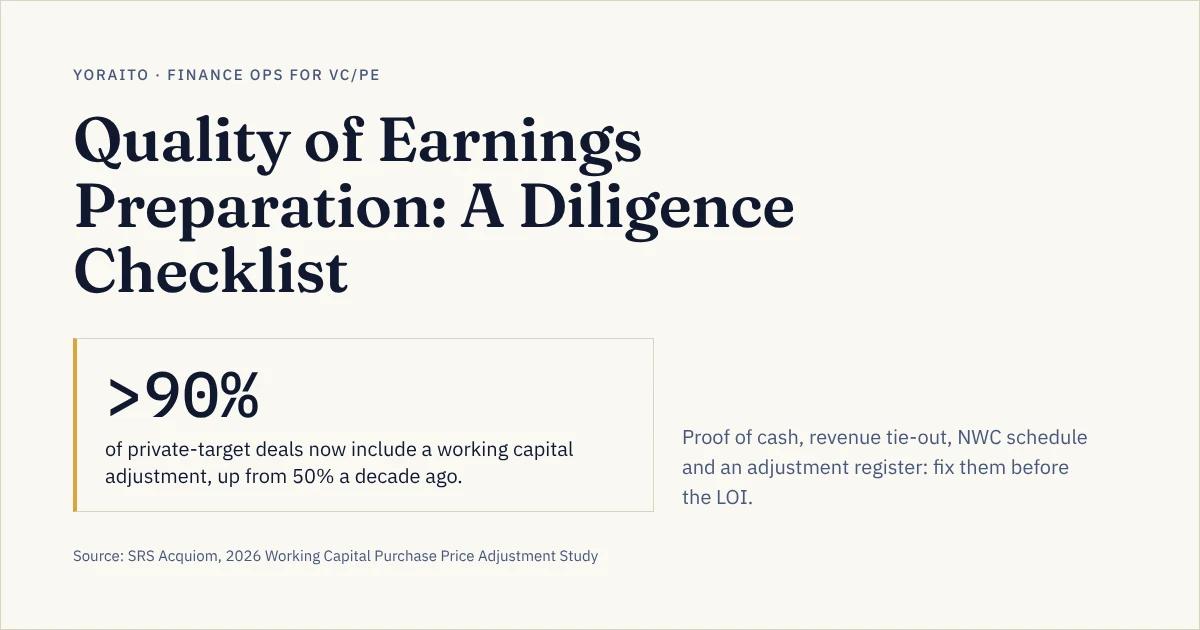
That last one matters more than it used to. SRS Acquiom reports that working capital adjustments now appear in more than 90% of private-target deals, up from 50% a decade ago (SRS Acquiom, 2026 Working Capital PPA Study). If your monthly working capital is noisy, the peg is where you pay for it.
How is a QoE different from an audit?
Many finance teams assume a clean audit means a clean QoE. It helps, but the two answer different questions. If you have just been through a year-end audit, our PBC list guide covers the evidence auditors accept; a QoE asks for more of it, monthly, and at a lower threshold.
- Purpose: Audit: an opinion that statements are fairly presented under GAAP; QoE: whether earnings are sustainable and what cash they produce.
- Nature of work: Audit: an attest engagement; QoE: a consulting engagement with an agreed scope (Baker Tilly).
- Materiality: Audit: set for the annual statements; QoE: lower thresholds, so smaller items get questioned (Baker Tilly).
- Period: Audit: the fiscal year; QoE: usually a trailing twelve months, analyzed month by month.
- Main output: Audit: an opinion letter; QoE: adjusted EBITDA, proof of cash, net working capital trend and debt-like items.
The practical difference for a controller: an auditor samples, then forms an opinion on the year. A QoE team rebuilds months, and every month that does not tie becomes a question in the data room.
What does a QoE provider test first?
Warren Averett describes three core areas in most middle-market QoE work: adjusted EBITDA, proof of cash and working capital (Warren Averett). In practice the proof of cash comes first, because it tells the provider whether the ledger can be trusted at all.
Here is a simplified receipts-side proof of cash for one quarter. The numbers are illustrative, not from a real company.
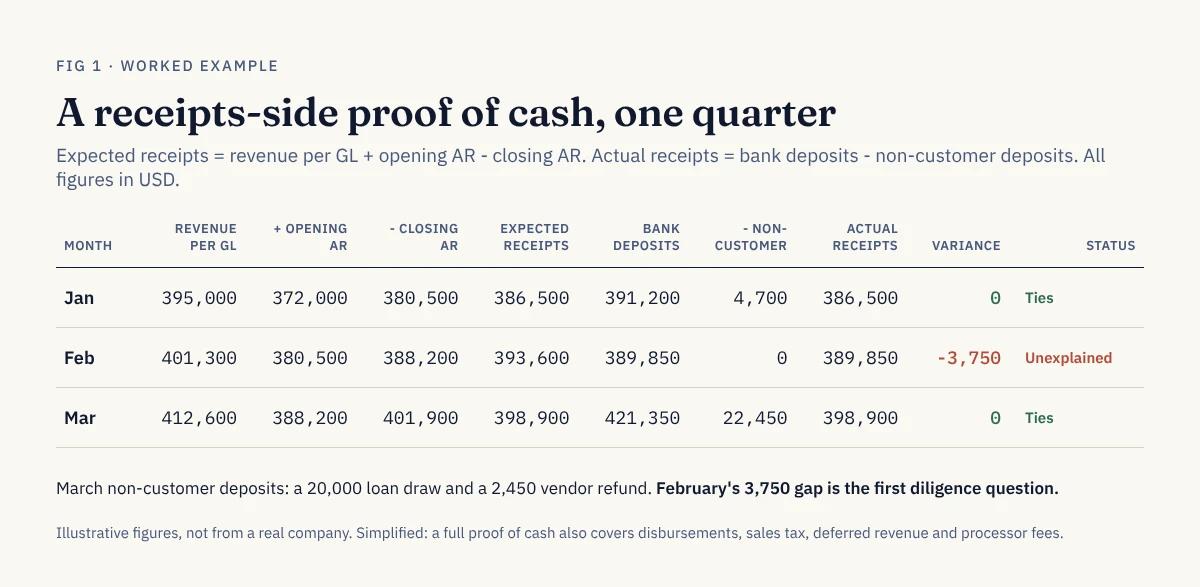
- January: Revenue per GL $395,000; plus opening AR $372,000; less closing AR $380,500; expected receipts $386,500; bank deposits $391,200 less $4,700 non-customer; actual receipts $386,500; variance $0.
- February: Revenue per GL $401,300; plus opening AR $380,500; less closing AR $388,200; expected receipts $393,600; bank deposits $389,850 less $0 non-customer; actual receipts $389,850; variance -$3,750, unexplained.
- March: Revenue per GL $412,600; plus opening AR $388,200; less closing AR $401,900; expected receipts $398,900; bank deposits $421,350 less $22,450 non-customer (a $20,000 loan draw and a $2,450 vendor refund); actual receipts $398,900; variance $0.
January and March tie. February does not, and the $3,750 gap will be the first question. It could be a credit memo posted to the wrong period, a card processor fee netted from a deposit, or a customer payment applied to the wrong month. Each is easy to explain in October. It is much harder to explain under a two-week diligence clock.
A real proof of cash also covers disbursements and handles sales tax, deferred revenue and processor fees. The point of the example is the shape: expected cash, actual cash, variance, explanation.
If your data sits in a warehouse or a clean export, the same test can be written once and rerun every month:
-- Monthly receipts-side proof of cash (illustrative schema)
WITH gl AS (
SELECT period, SUM(credit - debit) AS revenue
FROM gl_lines
WHERE account_type = 'revenue'
GROUP BY period
),
bank AS (
SELECT DATE_TRUNC('month', posted_date) AS period,
SUM(amount) FILTER (WHERE amount > 0) AS deposits,
SUM(amount) FILTER (WHERE amount > 0 AND category <> 'customer') AS non_customer
FROM bank_transactions
GROUP BY 1
)
SELECT g.period,
g.revenue + a.opening_ar - a.closing_ar AS expected_receipts,
b.deposits - b.non_customer AS actual_receipts,
(b.deposits - b.non_customer)
- (g.revenue + a.opening_ar - a.closing_ar) AS variance
FROM gl g
JOIN ar_rollforward a USING (period)
JOIN bank b USING (period)
ORDER BY g.period;
The value is not the query itself. It is that anyone, including the buyer's team, can rerun it on the same data and get the same variance. That is what we mean by matches that explain themselves.
Want every reconciliation to come with the source rows, the rule and the SQL behind it? Join the Yoraito waitlist for early access.
How do you prepare your books for quality of earnings?
Most seller-side prep guides list documents to gather. Gathering is the easy part. The work is making each document tie to the next one. Use this checklist six to twelve months before you expect a process.
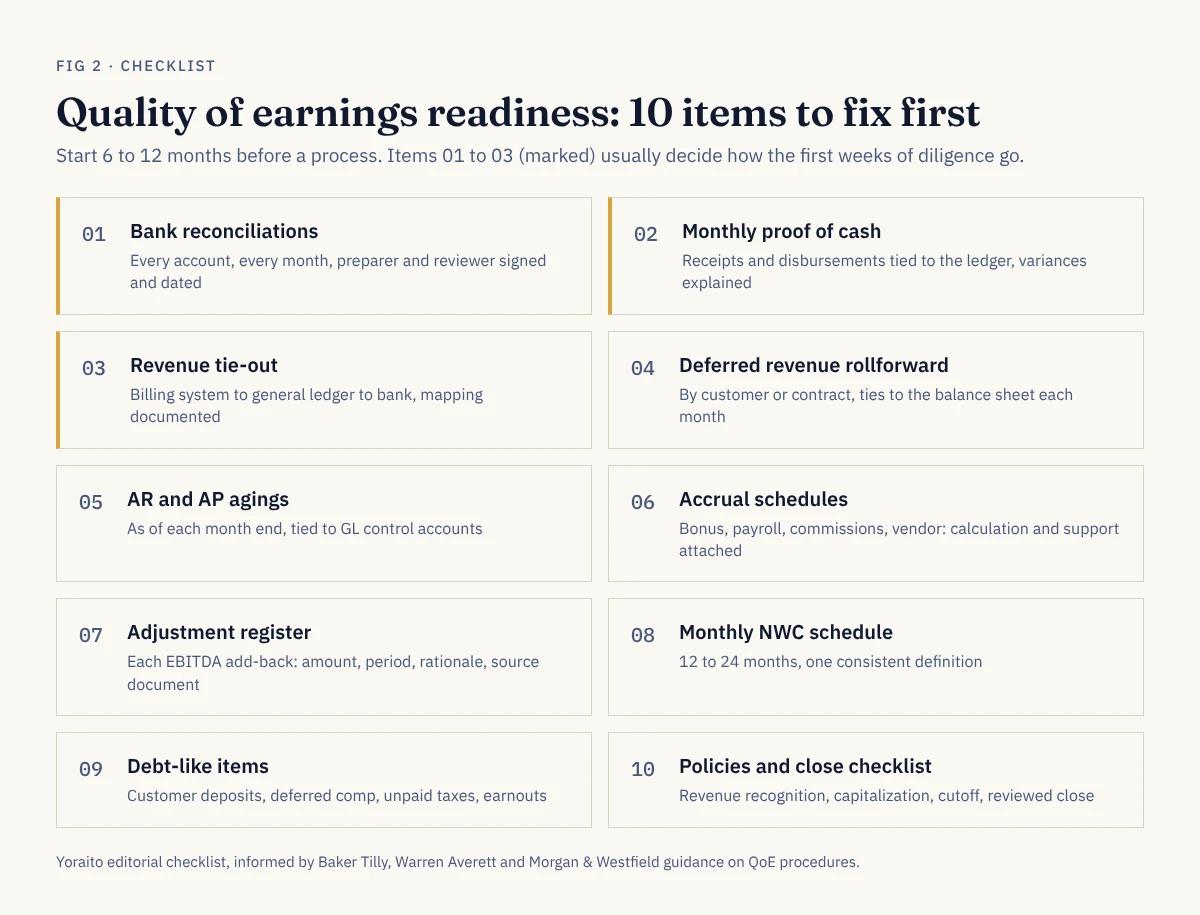
- 1. Bank reconciliations: every account, every month of the diligence period, with preparer, reviewer and date, and no unexplained reconciling items carried for months.
- 2. Monthly proof of cash: receipts and disbursements tied to the ledger for each month, with variances explained in writing.
- 3. Revenue tie-out: billing system to general ledger to bank, by month, with the mapping documented.
- 4. Deferred revenue rollforward: by customer or contract, tying to the balance sheet each month end.
- 5. AR and AP agings: run as of each month end and tied to the GL control accounts.
- 6. Accrual schedules: bonus, payroll, commissions and vendor accruals with the calculation and support attached.
- 7. Adjustment register: every proposed EBITDA add-back with an amount, period, rationale and source document.
- 8. Monthly net working capital schedule: 12 to 24 months, using one consistent definition of what is in and out.
- 9. Debt and debt-like items: customer deposits, deferred compensation, unpaid taxes, earnouts and anything a buyer may deduct from price.
- 10. Written policies and close checklist: revenue recognition, capitalization and cutoff policies, plus evidence the close was reviewed.
Items 1 to 3 are the ones that most often decide how the first weeks go. Morgan & Westfield lists "unreconcilable data" and improper revenue recognition among the common findings that hurt sellers (Morgan & Westfield). Our post on what auditors ask about AI reconciliation covers the reviewer evidence side in more depth.
Which EBITDA adjustments survive diligence?
Warren Averett groups adjustments into three types: management-proposed, due diligence (found by the advisor) and pro forma (expected go-forward changes). Baker Tilly notes that seller adjustments should be validated against original documentation, and that estimates get challenged. The rule of thumb: an add-back with a document survives, an add-back with a story gets negotiated.
- Owner or founder compensation above market: keep payroll records and a written basis for the market figure.
- One-time legal or advisory fees: keep invoices and a short description of the matter, showing it will not recur.
- Non-recurring bonuses: keep board or comp committee approvals and the payout calculation.
- Discontinued product or location costs: keep the decision record and the GL detail isolating the costs.
- Pro forma revenue from a new contract: keep the signed contract and the start date; expect a haircut if it is not yet billing.
Keep these in one register, not in email threads. When a buyer's team asks "where does the $85,000 add-back come from," the answer should be a row with a link, not a search through someone's inbox.
How far ahead should you start?
Timelines vary by provider and by how fast you answer requests. Warren Averett says most middle-market analyses take three to four weeks; Morgan & Westfield puts a typical study at 30 to 45 days and notes that timing depends on how quickly management supplies information. Either way, the fieldwork window is short. The cleanup cannot fit inside it.
A workable sequence for a PE-backed or VC-backed finance team:
- 6 to 12 months before a process: close any reconciliation gaps, start the adjustment register, agree one working capital definition.
- 3 months before: run proof of cash monthly, tie revenue from billing to bank, draft the debt-like items list.
- During diligence: keep closing on time, answer requests from the same schedules you already maintain, and log every question and answer.
Where do controllers lose time during diligence?
Three patterns come up again and again in seller-side guidance.
Spreadsheet logic nobody else can follow. A reconciliation that lives in one person's workbook, with hardcoded plugs, has to be rebuilt before it can be defended.
Numbers that change between versions. If the April NWC figure in the data room differs from the one in the board pack, the buyer will ask which is right and why both exist.
Finance team bandwidth. RWR notes that diligence lands on the same team running the close, and recommends planning for that capacity before the process starts (RWR).
The fix for all three is the same: produce each schedule from source data in a way that can be rerun, and keep the evidence next to the number.
FAQ
How long does a quality of earnings review take?
Published estimates run from about three weeks to six weeks. Warren Averett cites three to four weeks for most middle-market analyses, and Morgan & Westfield cites 30 to 45 days. The biggest driver is how fast the seller answers requests.
How much does a quality of earnings report cost?
Morgan & Westfield puts the range from about $5,000 for a minimal report on a small business to over $100,000 for a comprehensive study of a mid-sized company. Scope, revenue size and the state of the books drive the fee.
Is a quality of earnings report the same as an audit?
No. An audit is an attest engagement that gives an opinion on GAAP financial statements. A QoE is a consulting engagement that tests whether earnings are sustainable and backed by cash, usually month by month and at a lower materiality.
Should a seller get a sell-side QoE?
Many advisors recommend it, because it surfaces problems while the seller still controls the timeline. Whether it pays off depends on deal size and how clean the books already are. Talk to your banker and your accounting advisor before engaging one.
What documents does a QoE provider request?
Expect historical and interim financial statements, monthly trial balances, general ledger detail, bank statements and reconciliations, AR and AP agings, payroll records, tax returns, debt agreements, forecasts and major contracts. Morgan & Westfield cites three to five years of historical statements.
What should you do this week?
Pick the last three closed months and run a receipts-side proof of cash. If all three tie, you are ahead of most sellers. If one does not, you have found your first diligence question while there is still time to answer it calmly.
To hear when Yoraito opens up, join the waitlist.