
ASU 2025-06: When Can You Capitalize AI Software Costs?
ASU 2025-06 drops project stages for internal-use software. Here is how AI subscriptions, internal AI builds and model training costs are treated, when it takes effect, and what evidence your auditor will want.
Your team spent two quarters building an AI agent that codes vendor invoices. Under ASU 2025-06, whether that spend lands on the balance sheet no longer depends on which "stage" the project was in. It depends on what you can prove about the project, and when.
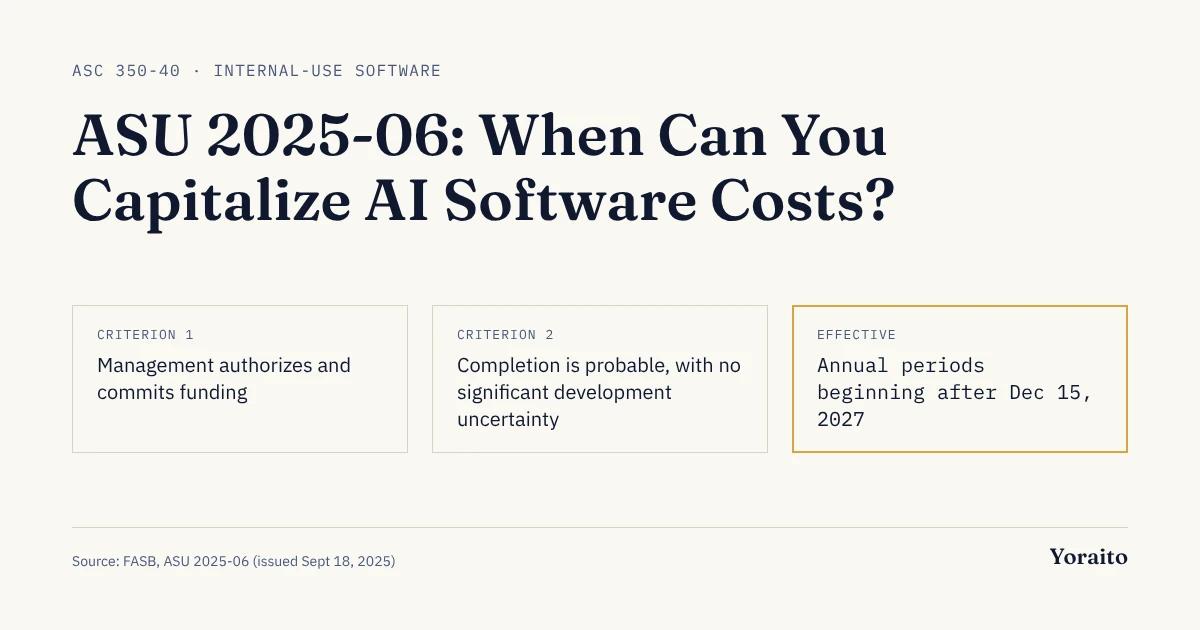
TL;DR: ASU 2025-06 drops the project-stage model for internal-use software. Capitalization starts when management authorizes and commits funding and completion is probable, but not while significant development uncertainty remains. Novel AI builds may stay expensed longer. AI subscriptions stay expensed. It is effective for annual periods beginning after December 15, 2027.
What is ASU 2025-06?
ASU 2025-06 is the FASB update that replaces the stage-based rules for capitalizing internal-use software costs (ASC 350-40) with a threshold based on management commitment and probable completion. The FASB issued it on September 18, 2025 (Crowe, Sept 2025).
The old guidance sorted costs into three stages: preliminary project, application development and post-implementation. That model assumed a waterfall build. The FASB's stated reason for the change was that software is now built with "more incremental and iterative" methods such as agile development, where stages blur together (Crowe, citing the ASU).
Three things changed:
- Stages are gone. All references to project stages are removed from Subtopic 350-40 (ASU 2025-06, FASB).
- A new threshold decides when capitalization starts. It is covered in the next section.
- Website development costs move in. Subtopic 350-50 is superseded and its website-specific guidance is folded into 350-40.
What did not change matters just as much. Per Baker Tilly, the ASU does not change "the types of costs that qualify for capitalization," when capitalization stops, or the guidance for external-use software (Baker Tilly, Jan 2026).
When does ASU 2025-06 take effect?
The ASU is "effective for all entities for annual reporting periods beginning after December 15, 2027, and interim reporting periods within those annual reporting periods" (FASB). There is no later date for private companies. The board considered a deferral and decided against it (Crowe).
- Calendar-year company: first applies on January 1, 2028.
- April fiscal year: first applies to the year beginning April 1, 2028.
- Early adoption: permitted, as of the beginning of an annual reporting period.
You also pick a transition method:
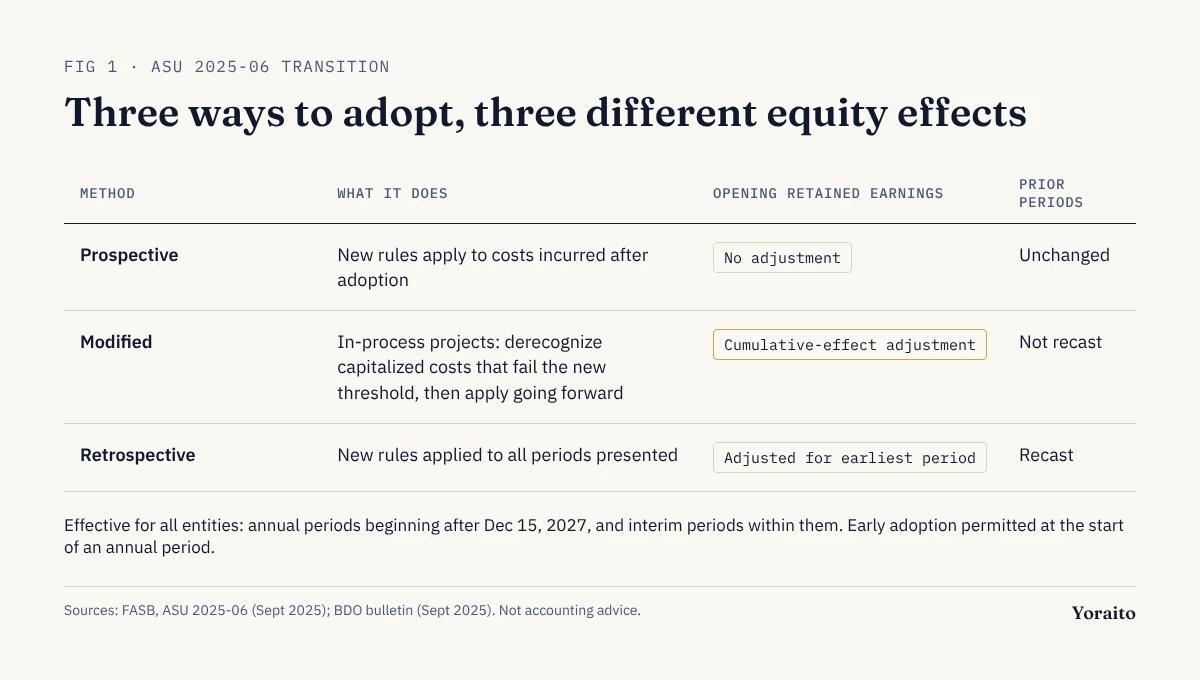
- Prospective: apply the new rules to costs incurred after adoption; no change to opening equity.
- Modified: for in-process projects, derecognize previously capitalized costs that fail the new threshold through a cumulative-effect adjustment to opening retained earnings, then apply the rules going forward (BDO, Sept 2025).
- Retrospective: recast all comparative periods presented.
For a company with a few small software projects, prospective is usually the least work. If you have a large in-process AI build with costs already capitalized under the old stages, run the modified test before you choose, so the equity impact is a decision and not a surprise.
Want every capitalization decision to come with its approval date, cost rows and the query behind the number? Join the Yoraito waitlist for early access.
What are the new capitalization criteria?
Under amended 350-40-25-12, capitalization begins when both of these occur:
- Management authorizes and commits to funding the software project.
- It is probable that the project will be completed and the software will be used to perform the function intended.
The second criterion is not met while significant development uncertainty exists. Significant development uncertainty is present when software has novel, unique or unproven functions or features not yet resolved through coding and testing, or when its significant performance requirements are not identified or keep being substantially revised (FASB, 350-40-25-12A).
That second factor is the one controllers will see most. A project whose requirements change every sprint has not cleared the threshold, however much the team has spent.
How does ASU 2025-06 apply to AI projects?
The ASU contains no AI-specific guidance. But AI work sorts cleanly once you ask two questions: who will use the software, and is anything about it unproven? Here is how common AI spend maps:
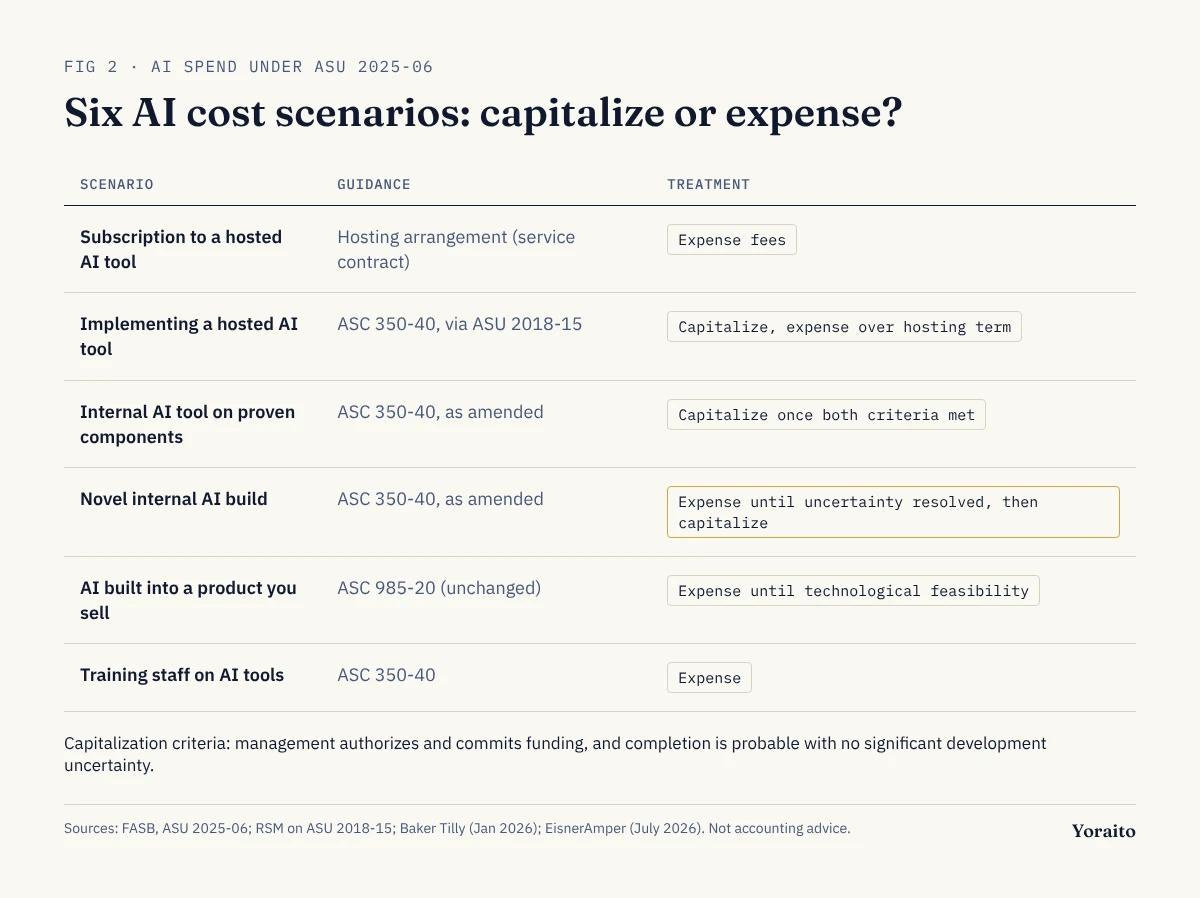
- Subscription to a hosted AI tool: a hosting arrangement that is a service contract; fees are expensed as incurred.
- Implementing that hosted tool (configuration, integration): capitalized under 350-40 and expensed over the term of the hosting arrangement, presented with the hosting fees (RSM on ASU 2018-15). BDO's examples show these implementation costs follow the new threshold too.
- Internal AI tool built on proven components: capitalize once funding is committed and completion is probable; little development uncertainty if the features are known.
- Novel internal AI build (unproven features or shifting requirements): expense until the uncertainty is resolved through coding and testing; then capitalize.
- AI built into a product you sell: outside 350-40; ASC 985-20 applies, and costs are expensed until technological feasibility (ASU 2025-06 does not change external-use guidance).
- Training staff to use any AI tool: expensed as incurred (RSM).
What about the cost of training a model? EisnerAmper's view is that training an LLM, validating outputs and optimizing it are analogous to coding, so those costs can be capitalized once the criteria are met (EisnerAmper, July 2026). That is one firm's reading, not FASB text. Agree the treatment with your auditor before year-end, not during fieldwork.
The practical effect for AI: a novel build is more likely to sit in "significant development uncertainty" for longer than a typical ERP integration, so more early spend may be expensed. EisnerAmper makes a similar point for external-use AI, noting that technological feasibility will likely come "at a much later stage" than for conventional software.
What evidence will your auditor want?
Removing stages removes a convenient label, not the need for proof. The capitalization date now rests on judgments about commitment, probability and uncertainty, and an auditor will test each one. Baker Tilly lists the documentation companies will need: project identification, management approvals, evaluation of performance requirements, the coding and testing done to resolve uncertainty, and the factors used to decide whether features are novel or unproven.
A working checklist for each AI project:
- Authorization: a dated approval with the approver's name and the committed budget.
- Requirements log: the significant performance requirements, with a change history, so you can show when they stopped being substantially revised.
- Uncertainty register: each novel or unproven feature, the test that resolved it and the date.
- Capitalization start memo: the date both criteria were met and why.
- Cost tagging: time and invoices tagged to the project, split before and after the start date.
- Ready-for-use date: when amortization begins.
- Disclosure tie-out: capitalized costs now follow the Subtopic 360-10 property, plant and equipment disclosure requirements (FASB).
If costs are tagged by project and date, the split is a query, not a spreadsheet exercise. A simple version:
SELECT c.project_id,
       SUM(c.amount) FILTER (WHERE c.cost_date <  p.cap_start_date) AS expensed,
       SUM(c.amount) FILTER (WHERE c.cost_date >= p.cap_start_date
                               AND c.cost_type IN ('internal_dev','contractor_dev')) AS capitalized,
       SUM(c.amount) FILTER (WHERE c.cost_type = 'training') AS training_expensed
FROM   project_costs c
JOIN   software_projects p ON p.project_id = c.project_id
GROUP  BY c.project_id;
The output ties to the general ledger, and cap_start_date points back to a memo an auditor can read. If you already keep audit evidence this way for reconciliations, the habit carries over. Our PBC list guide covers the same principle for year-end requests.
A worked example (illustrative). A company with a calendar year adopts in 2028. In February, the CFO approves $300,000 for an AI agent that matches vendor invoices to POs, with a new feature that learns vendor-specific coding. Through April, the learning feature fails acceptance tests and requirements change twice. In May, testing shows the feature meets its accuracy target and requirements freeze. Costs from February to April ($110,000) are expensed. Development costs from May onward are capitalized until the tool is ready for use. Training the AP team is expensed. The May memo, the test results and the requirements log are what make the $110,000 line defensible.
Should you adopt ASU 2025-06 early?
Early adoption is a judgment call, and this is not accounting advice. Points worth weighing with your auditor:
- You run agile AI projects today. Forcing them into waterfall stages may already be awkward and hard to document.
- Comparability. Investors and lenders may prefer consistency with peers who adopt on the required date.
- Systems readiness. You need project-level cost tagging and the evidence above before the first period you apply it.
- Diligence timing. If a fundraise or sale is coming, think about how a change in policy will read in a quality of earnings review.
If you are evaluating AI tools now, the same documentation habit helps on the buying side. Our AI accounting software RFP questions and 30-day pilot scorecard show how to collect evidence on a tool before you commit budget, which is also when your authorization date starts. For why measured, checkable results matter more than spend, see AI in finance ROI.
FAQ
Is ASU 2025-06 effective now?
Not yet, unless you adopt early. It applies to annual reporting periods beginning after December 15, 2027, and interim periods within them, for all entities. A calendar-year company first applies it on January 1, 2028. Early adoption is allowed as of the start of an annual period.
Can I capitalize a ChatGPT, Copilot or other AI subscription?
Generally no. A hosted AI subscription is usually a hosting arrangement that is a service contract, so the fees are expensed. Certain implementation costs, such as configuration and integration, can be capitalized under ASC 350-40 and expensed over the term of the arrangement.
Does ASU 2025-06 apply to private companies?
Yes. The effective date is the same for public and private entities. The FASB considered extra time for private companies and decided against it.
Can you capitalize the cost of training an AI model?
Possibly, for internal-use software, once management has committed funding and completion is probable with no significant development uncertainty left. Some firms treat model training as analogous to coding. Training employees to use AI tools is always expensed.
Get your evidence in place before 2028
Pick your largest AI project and write down three dates: when it was authorized, when its requirements stopped changing and when its novel features passed testing. If you cannot find evidence for one of them, that is the gap to close before adoption. Yoraito is built so finance teams and auditors can check the work behind a number, not trust a black box. To hear when Yoraito opens up, join the waitlist.