
PE Portfolio Reporting: What Operating Partners Expect
What PE operating partners read first in a portfolio company's monthly reporting pack, when it is due, and the tie-out checks that keep numbers from changing between versions.
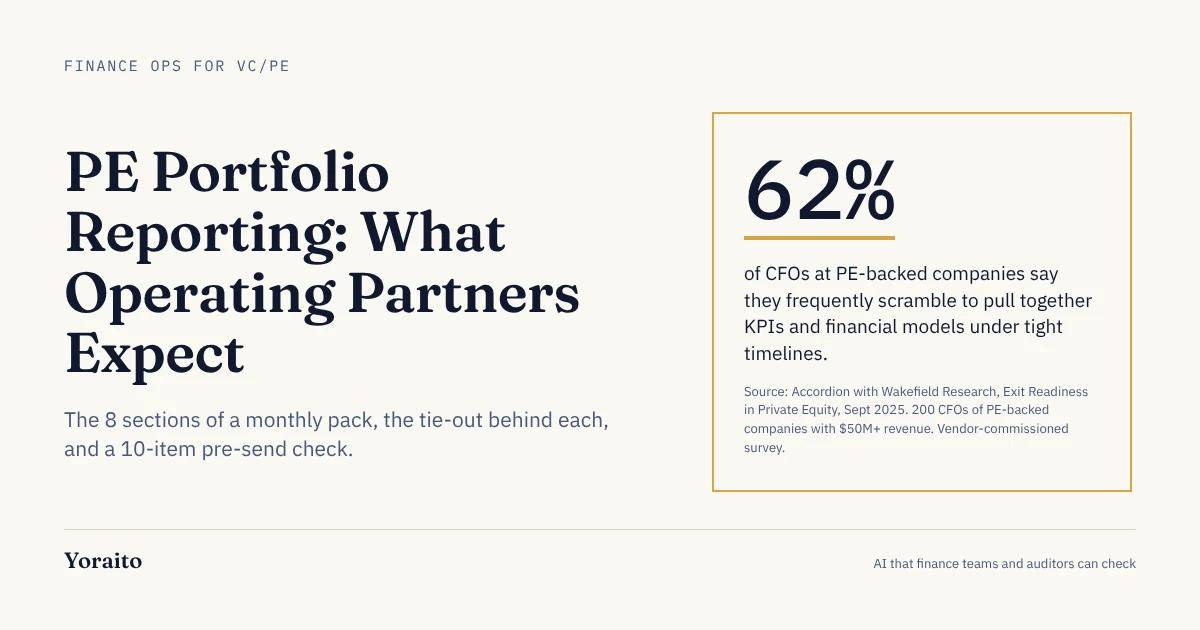
An operating partner reads your monthly pack in a fixed order: results against plan, then cash, then the handful of KPIs the deal was underwritten on. The first time a number changes between versions, they stop reading and start asking questions.
TL;DR: PE portfolio reporting works when the monthly pack answers the sponsor's questions in their order and every figure ties back to the ledger. Send a flash within days, the full pack on an agreed date, keep a written definition for each thesis KPI, and run tie-out checks before anything leaves finance.
What is a PE portfolio reporting pack?
A PE portfolio reporting pack is the set of financial statements, KPIs and commentary a portfolio company sends its private equity sponsor each month, so the deal team can track performance against the investment plan.
Four more terms you will hear from the deal team:
- Flash report: a short early read of the month (revenue, EBITDA, cash) sent before the books are fully closed.
- Thesis KPIs: the three to six operating metrics tied to how the deal was underwritten.
- KPI definition log: a written record of how each metric is calculated, from which source data, and when the definition last changed.
- Covenant headroom: the gap between your actual ratios and the limits in your credit agreement.
The monthly pack is not the board deck. It is the operating record the board deck is built from. Sponsors usually set reporting requirements in the investment or shareholder agreement, and lenders set theirs in the credit agreement. When the two define EBITDA differently, the pack has to show both and reconcile them.
What do operating partners read first?
Aleph, a vendor of FP&A software, lays out a typical sponsor review order in its guide to PE reporting requirements (Aleph):
- 1. Revenue and EBITDA versus plan, with variance analysis.
- 2. Cash position, including headroom and runway.
- 3. Investment thesis KPIs, the three to six metrics tied to deal underwriting.
- 4. Forecast revisions, with an explanation for each change.
- 5. Covenant headroom, measured against the agreement's definitions.
That order matches what sponsors say worries them. In a September 2025 survey commissioned by Accordion, a PE-focused consulting firm, and run with Wakefield Research, 67% of 200 sponsors cited data quality as a persistent weak spot. Among 200 CFOs of PE-backed companies with $50M or more in revenue, 62% said they frequently scramble to pull together KPIs and financial models under tight timelines, and 44% pointed to fragmented systems (Accordion, Exit Readiness in Private Equity, 2025).
The pack's problem is rarely its layout. It is whether the numbers arrive on time and hold up the first time.
What goes in the monthly pack, section by section?
Most guides list sections. The useful question is what must be true behind each one.
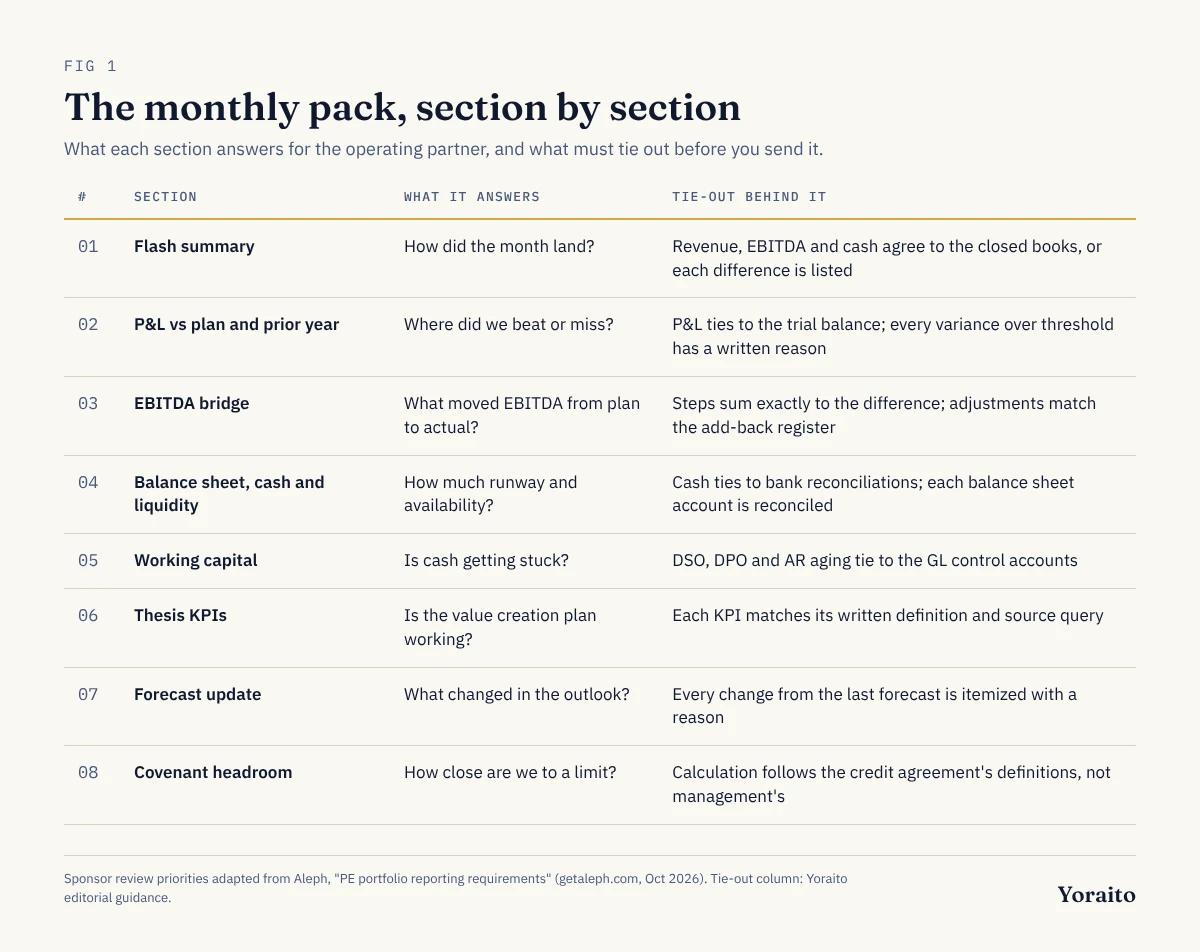
- 1. Flash summary: answers how the month landed; tie-out: revenue, EBITDA and cash agree to the closed books, or each difference is listed.
- 2. P&L versus plan and prior year: answers where we beat or missed; tie-out: the P&L ties to the trial balance, and every variance over your threshold has a written reason.
- 3. EBITDA bridge: answers what moved EBITDA from plan to actual; tie-out: the bridge steps sum exactly to the difference, and adjustments match the add-back register.
- 4. Balance sheet, cash and liquidity: answers how much runway and availability we have; tie-out: cash ties to the bank reconciliations, and each balance sheet account is reconciled.
- 5. Working capital: answers whether cash is getting stuck; tie-out: DSO, DPO and the AR aging tie to the GL control accounts.
- 6. Thesis KPIs: answers whether the value creation plan is working; tie-out: each KPI matches its written definition and source query.
- 7. Forecast update: answers what changed in the outlook; tie-out: every change from the last forecast is itemized with a reason.
- 8. Covenant headroom: answers how close we are to a limit; tie-out: the calculation follows the credit agreement's definitions, not management's.
Sections 4 and 5 lean on the same evidence your auditor asks for at year end. If those reconciliations already meet the bar in our PBC list guide, the monthly version is mostly a matter of running them every month instead of once.
When is the monthly pack due?
The binding dates live in your agreements, so read those first. As a reference point, Aleph's guide gives these typical ranges:
- Flash results: monthly, 3 to 10 business days after month end.
- Full management pack: monthly, 10 to 20 business days after month end.
- Board pack: quarterly, 5 to 7 days before the meeting.
- Covenant compliance certificate: quarterly, on the schedule set by the credit agreement.
A guide from Allegro Grey on PE CFO reporting adds a rule worth copying for the flash: "each variance from plan needs a one to two sentence explanation" (Allegro Grey).
The timing has a knock-on effect. A full pack due on business day 10 means bank reconciliations, accruals and the EBITDA bridge are done well before that. If your reconciliation step still depends on someone matching rows by hand, that is where the deadline gets lost. Our post on how AI bank reconciliation matches should be explained covers what a reviewable match looks like.
Want every number in the pack to come with the source rows, the rule and the SQL behind it? Join the Yoraito waitlist for early access.
How do you stop numbers changing between versions?
Aleph names the problem "definition drift": a KPI calculated one way in March and another way in June. A second cause is quieter. The flash goes out, then a late entry changes the closed number, and the full pack silently shows a different figure.
Here is an illustrative case. The flash reports September revenue of $2,410,000. On business day 6, a $38,000 credit memo is posted to September. Closed revenue is now $2,372,000. If the full pack simply shows the new number, the operating partner sees two answers and no explanation. If it shows both, with one line saying a $38,000 credit memo was posted after the flash, the question is answered before it is asked.
Two habits prevent most of this.
Keep a KPI definition log. One row per metric, for example:
- KPI: net revenue retention.
- Definition: recurring revenue this month from customers active 12 months ago, divided by their recurring revenue 12 months ago.
- Source: billing system subscription table, as of month-end close.
- Owner and approver: FP&A lead; CFO.
- Version and change date: v2, changed March 2026 to exclude one-time services revenue, agreed with the sponsor.
Run a tie-out query before sending. If your ledger data sits in a warehouse or a clean export, the check can be written once and rerun every month:
-- Pre-send tie-out: pack figures vs general ledger (illustrative schema)
SELECT p.period,
p.line_item,
p.pack_value,
g.gl_value,
p.pack_value - g.gl_value AS difference
FROM pack_figures p
JOIN (
SELECT l.period, m.pack_line AS line_item, SUM(l.amount) AS gl_value
FROM gl_lines l
JOIN account_map m ON m.account_id = l.account_id
GROUP BY l.period, m.pack_line
) g ON g.period = p.period AND g.line_item = p.line_item
WHERE p.period = '2026-09'
AND ABS(p.pack_value - g.gl_value) > 0.5;
An empty result means every pack line ties to the ledger. Any row returned is something to fix or explain before the pack goes out. The point is not the query. It is that anyone, including the sponsor's team, can rerun it on the same data and get the same answer. That same principle is why AI journal review needs governance, not just automation.
What should you check before the pack goes out?
Use this as a pre-send checklist.
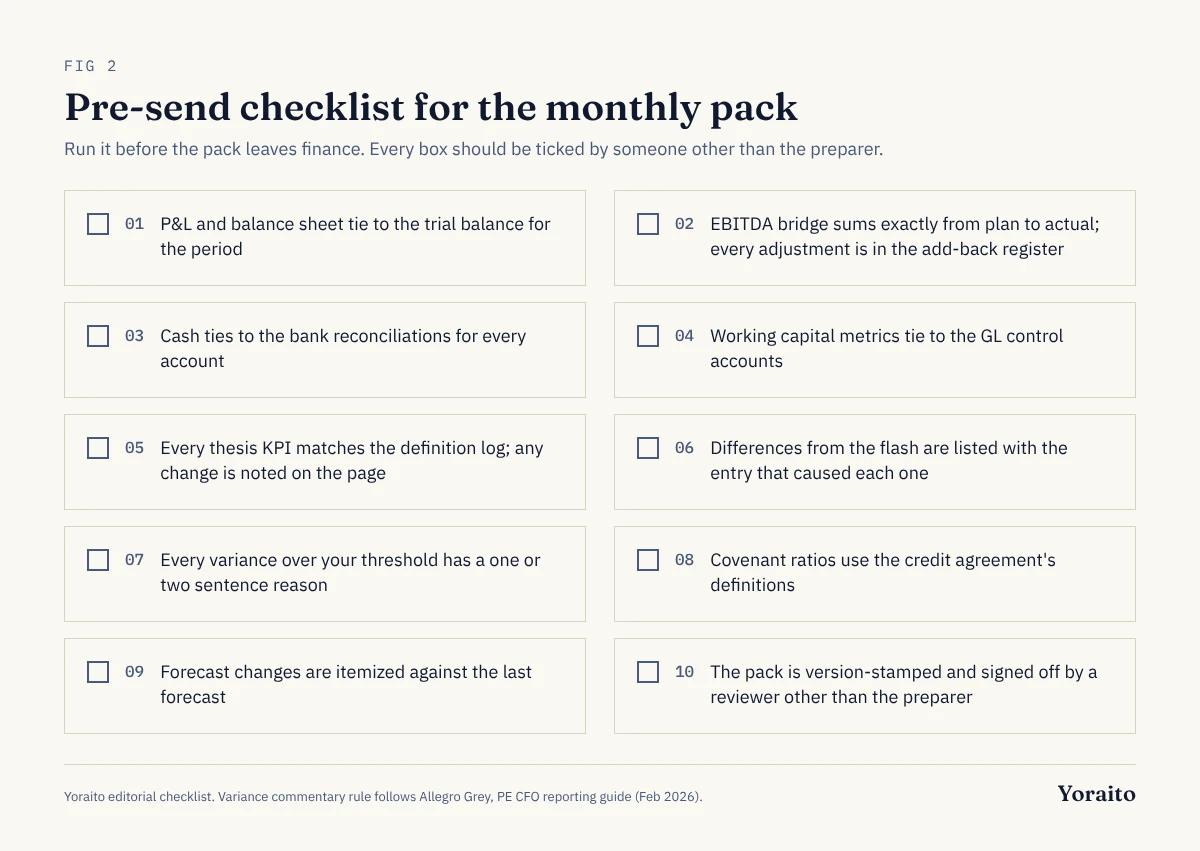
- 1. P&L and balance sheet tie to the trial balance for the period.
- 2. EBITDA bridge sums exactly from plan to actual, and every adjustment is in the add-back register.
- 3. Cash ties to the bank reconciliations for every account.
- 4. Working capital metrics tie to the GL control accounts.
- 5. Every thesis KPI matches the definition log, and any definition change is noted on the page.
- 6. Differences from the flash are listed with the entry that caused each one.
- 7. Every variance over your threshold has a one or two sentence reason.
- 8. Covenant ratios use the credit agreement's definitions.
- 9. Forecast changes are itemized against the last forecast.
- 10. The pack is version-stamped and signed off by a reviewer other than the preparer.
For the reviewer evidence side of items 3 and 10, our post on what auditors ask about AI reconciliation goes deeper.
Will ILPA's refreshed template change what sponsors ask for?
Possibly, and indirectly. The ILPA Portfolio Company Metrics Template was first released in March 2019 and is used for reporting from fund managers to their investors. In March 2026, ILPA started a refresh to "refine and right-size the template," with the final version due in early 2027 (ILPA). ILPA's template page lists a public comment period open through October 16, 2026 (ILPA template page).
The template is not addressed to portfolio companies. But your sponsor fills its LP reports from your data. If your sponsor adopts the refreshed version, expect requests for company-specific KPIs in a more consistent format. A definition log you already keep makes that request a copy and paste instead of a project.
FAQ
What is a flash report in private equity?
A flash report is a short early read of the month, usually revenue, EBITDA and cash against plan, sent to the sponsor before the full close is finished. It trades completeness for speed, so differences from the final numbers should be listed when the full pack follows.
How soon after month end is a PE reporting pack due?
It depends on your investment and credit agreements. As a reference, Aleph's guide cites 3 to 10 business days for a flash and 10 to 20 business days for the full management pack. Agree the dates with your sponsor in writing.
What KPIs do PE sponsors track for portfolio companies?
Revenue and EBITDA against plan come first, then cash and liquidity, working capital measures such as DSO and DPO, covenant ratios, and three to six thesis KPIs tied to the deal's value creation plan. The thesis KPIs differ by company.
What is the difference between a monthly pack and a board pack?
The monthly pack is the full operating record: statements, variances, cash, KPIs and forecast. The board pack is usually quarterly, shorter and built around decisions and strategy. Most of the board pack's numbers should come straight from the monthly packs.
What should you do this week?
Take last month's pack and trace five numbers back to the trial balance: revenue, EBITDA, cash, DSO and your top thesis KPI. Then write the definition of that KPI in one sentence. If it only exists in someone's head, that is your first fix.
To hear when Yoraito opens up, join the waitlist.