
BlackLine vs FloQast vs Numeric for Lean Finance Teams
BlackLine, FloQast and Numeric compared on the facts for a lean finance team: what each says it is, pricing, admin load, and six auditability tests to run on your own data before you buy.
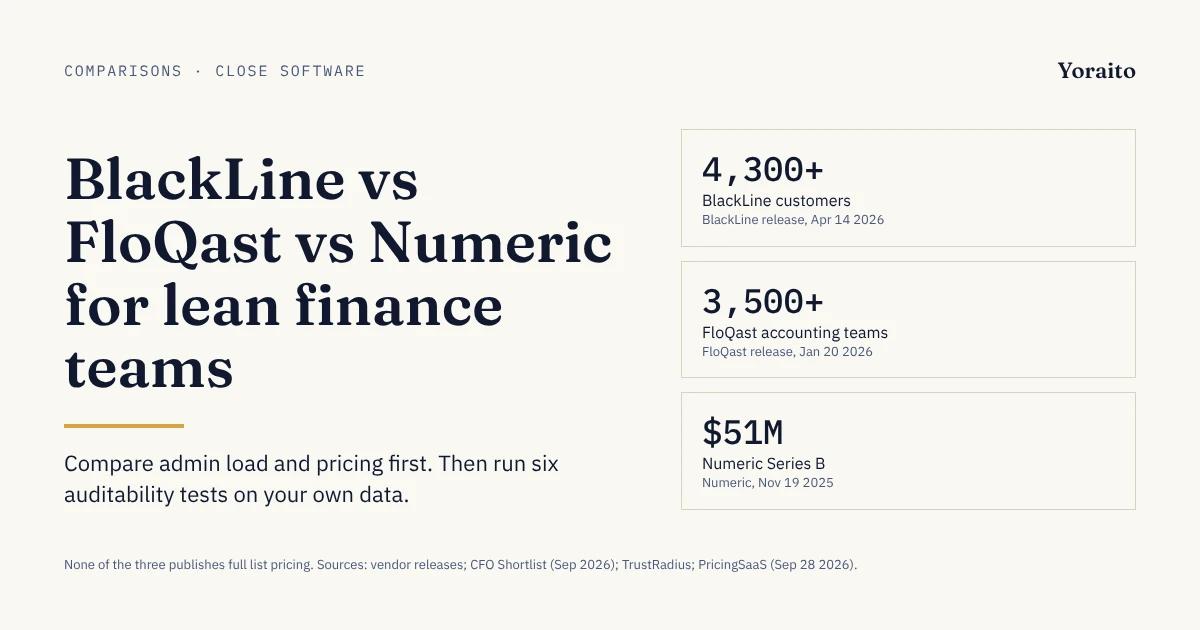
If your finance team is three people and no one has time to administer software, the usual BlackLine vs FloQast debate misses the question your auditor will ask: when the tool, or its AI, touches a reconciliation, can you show exactly what it did?
TL;DR: BlackLine, FloQast and Numeric all automate the month-end close, but they start from different places: BlackLine from enterprise reconciliation and controls, FloQast from accountants' existing workpapers, Numeric from a finance data platform. For a lean team, compare admin load and pricing first, then test each one's audit evidence on your own data.
What does each close tool say it is?
Start with each vendor's own words and the most recent dated fact. Everything below is sourced; verify current capabilities in a demo on your own data.
BlackLine calls itself "the future-ready platform for the Office of the CFO" and says "more than 4,300 customers across multiple industries" use it (BlackLine press release, April 14, 2026). In April 2026 it launched what it calls Agentic Financial Operations, built on its Studio360 platform and its Verity AI layer (Verity Prepare, Verity Match, and Verity Collect and Remit). Its CEO, Owen Ryan, said "a 'black box' solution is not an option," and the company described a "glass box" architecture in which "every action is traceable, auditable, and aligned to financial controls" (CPA Practice Advisor, April 15, 2026).
FloQast describes itself as "the Accounting Transformation Platform created by accountants for accountants." In January 2026 it said it had passed $200 million in annual recurring revenue and is "trusted by more than 3,500 global accounting teams" (FloQast, January 20, 2026). Its Excel integration "keeps your team in tools they already use and trust" (FloQast). Its homepage says its AI agents automate "reconciliations, close workflows, and journal entries," that "nothing hits your books without human approval," and that "every decision is traceable and exportable" (FloQast).
Numeric calls itself "the data platform for finance teams." It raised a $51 million Series B led by IVP in November 2025 and launched a cash management product, saying it is "evolving beyond our close management origins" (Numeric, November 19, 2025). Its homepage offers a close checklist shared by "humans & agents," agentic flux analysis and automatic balance sheet reconciliation, and now describes a Financial Data Platform that "replaces your ERP" (Numeric, accessed October 15, 2026).
Close management software is a system that organizes month-end tasks, reconciliations and review sign-offs on top of your general ledger, so the close is tracked in one place instead of in email and spreadsheets.
How do BlackLine, FloQast and Numeric compare side by side?
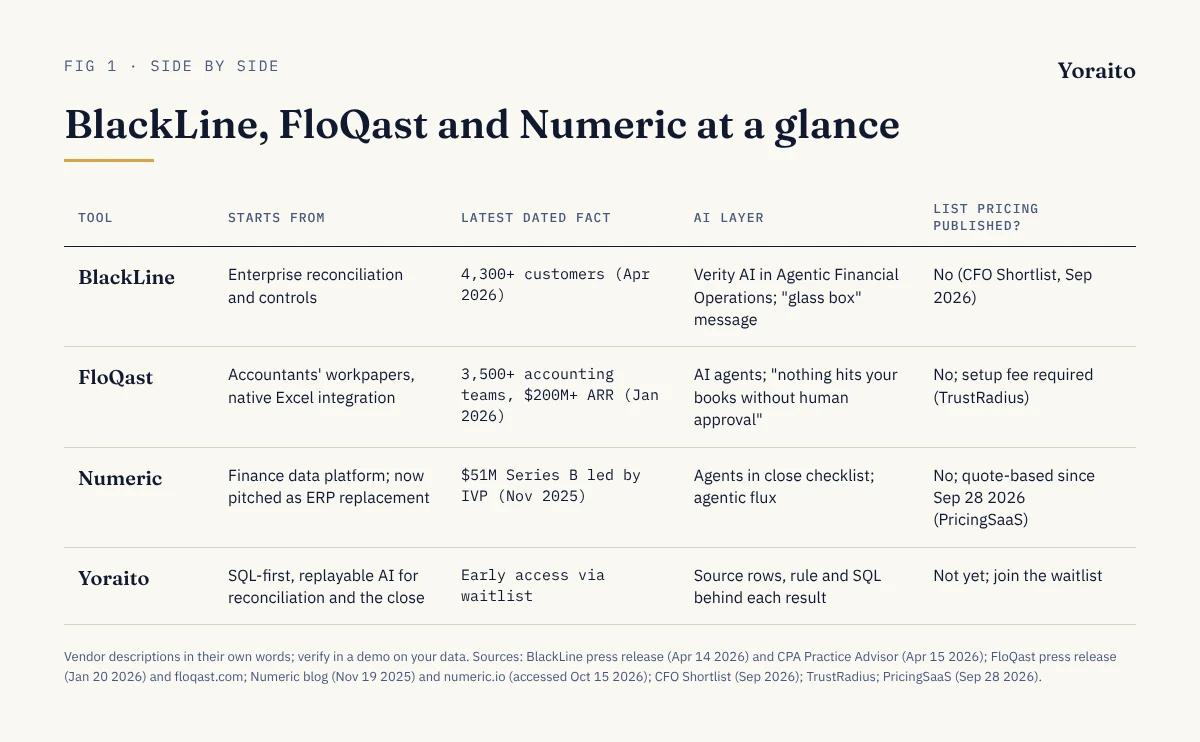
- BlackLine: starts from enterprise reconciliation and controls; 4,300+ customers (April 2026); AI layer: Verity AI inside Agentic Financial Operations; list pricing not published (per CFO Shortlist, September 2026).
- FloQast: starts from accountants' workpapers, with a native Excel integration; 3,500+ accounting teams and $200M+ ARR (January 2026); AI layer: AI agents with human approval before anything hits the books; list pricing not published, setup fee required (per TrustRadius).
- Numeric: starts from a finance data platform; $51M Series B (November 2025); AI layer: agents in the close checklist, agentic flux; plans are quote-based (per PricingSaaS, September 28, 2026).
- Yoraito: starts from SQL-first, replayable AI for reconciliation, invoice processing, Excel automation, compliance checks and the close; in early access through a waitlist.
None of the three publishes full list pricing. CFO Shortlist states that "BlackLine doesn't publish pricing" (CFO Shortlist, updated September 2026). TrustRadius lists no starting price for FloQast or Numeric and notes that FloQast requires a setup fee (TrustRadius). PricingSaaS reports that Numeric's three plans became quote-based on September 28, 2026 (PricingSaaS). Budget for a sales conversation with each.
What should a lean finance team weigh first?
Feature grids look similar across all three. For a team of two to five people, these questions usually decide it:
- Who administers it? Ask each vendor who on your side owns setup, user roles and integration upkeep, and how many hours a month that takes after go-live.
- How long to the first full close? Get the implementation estimate in writing, with the date of your first close run fully in the tool.
- Where do your workpapers live today? If your reconciliations are in Excel and work, FloQast's Excel approach changes the least. If you want to move off spreadsheets, weigh BlackLine's and Numeric's in-platform reconciliation.
- What does the ERP connection cover? Confirm your ERP is supported and which data syncs: trial balance only, or transaction detail as well.
- What is the total cost? The quote, the setup fee and your team's internal hours for implementation.
Want every reconciliation to come with the source rows, the rule and the SQL behind it? Join the Yoraito waitlist for early access.
What auditability tests do most comparisons skip?
Most comparison pages, including vendors' own, score checklists, reconciliation, flux and integrations. Few score the evidence your auditor will test. Under PCAOB AS 1105, when an auditor uses information produced by the company, they must "test the accuracy and completeness of the information, or test the controls over the accuracy and completeness of that information," including IT general controls and automated application controls where applicable (PCAOB AS 1105, paragraph .10). Reconciliations and AI-prepared matches exported from a close tool are that kind of information.
An auditable close tool is one where an auditor can trace any automated result back to its source data, the logic applied and the person who approved it, without relying on the vendor's word.
Run these six tests in every demo, on your own data:
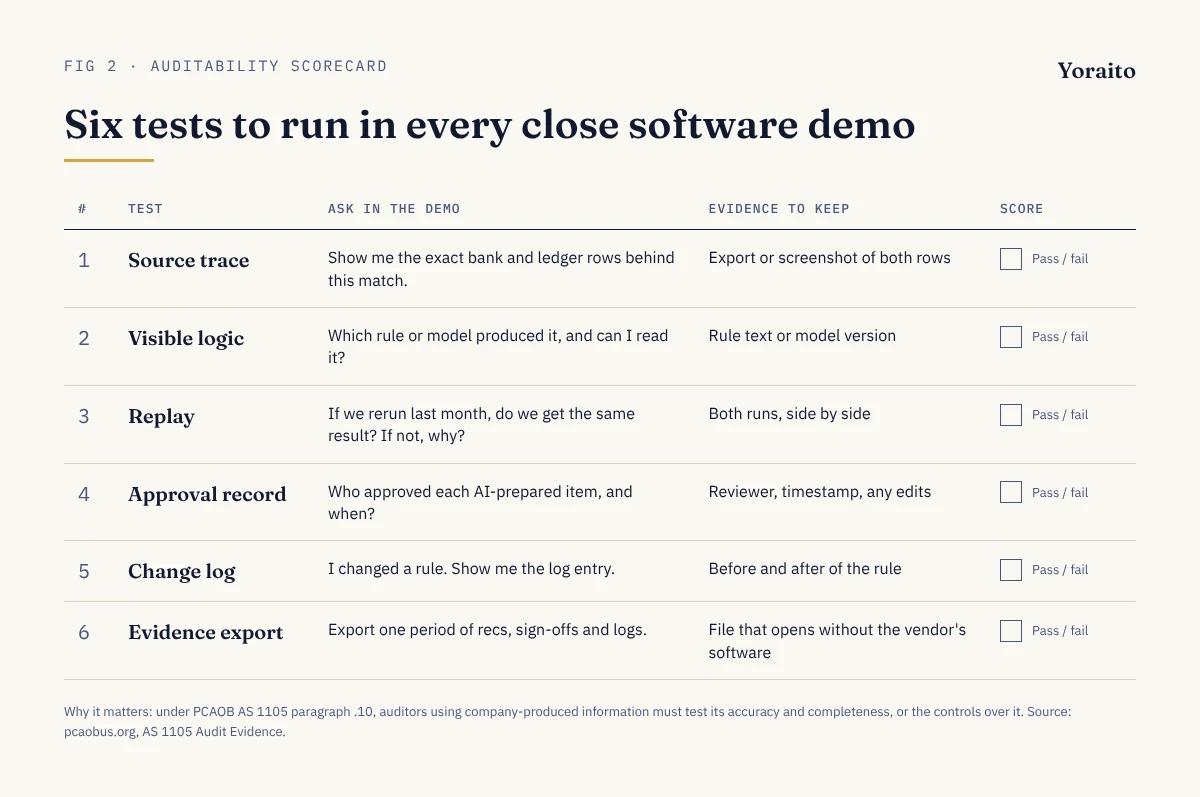
- Source trace: pick one automated match and ask to see the exact bank and ledger rows behind it. Keep a screenshot or export of both.
- Visible logic: ask which rule or model produced the match and whether you can read it. Keep the rule text or model version.
- Replay: ask what happens if you rerun last month. Does it return the same result, and if not, why? Keep both runs.
- Approval record: ask who approved each AI-prepared item and when. Keep the reviewer, timestamp and any edits.
- Change log: change a rule, then ask to see the log entry. Keep the before and after.
- Evidence export: ask for a full export of reconciliations, sign-offs and logs for one period. Keep the file and check it opens without the vendor's software.
BlackLine's and FloQast's public statements address traceability directly ("every action is traceable, auditable" and "every decision is traceable and exportable"). Numeric's homepage promises "full visibility into every action." Those are vendor statements. The tests turn them into evidence you can file. Our 12 audit trail questions for AI accounting software RFPs go deeper, and the AI audit trail checklist lists the fields each AI action should record.
How do you check a close tool's evidence export yourself?
Ask the vendor for a one-period export of reconciliations, then load it next to your trial balance. This query flags any reconciliation that does not tie to the GL, has no reviewer, or was reviewed before it was prepared:
-- Evidence export check: reconciliations that would fail an auditor's first look
SELECT
r.account_number,
r.reconciled_balance,
t.gl_balance,
r.reconciled_balance - t.gl_balance AS unexplained_difference,
r.preparer, r.prepared_at,
r.reviewer, r.reviewed_at
FROM vendor_rec_export r
JOIN trial_balance t
ON t.account_number = r.account_number
AND t.period = r.period
WHERE r.period = '2026-09'
AND (
r.reconciled_balance <> t.gl_balance
OR r.reviewer IS NULL
OR r.reviewed_at < r.prepared_at
)
ORDER BY ABS(r.reconciled_balance - t.gl_balance) DESC;
Zero rows is the result you want. Run the same query on each shortlisted tool's export during the trial, and keep the output with the date. It is the same evidence your auditor will look for on the year-end PBC list.
Where does Yoraito fit?
Yoraito is SQL-first, auditable AI for bank reconciliation, invoice processing, Excel automation, compliance checks and the financial close. It is built around the six tests above: every number the AI produces should come with the source rows, the rule and the SQL behind it, so a controller or an auditor can re-run it and get the same answer. Yoraito is in early access through a waitlist, so compare it the same way you compare the others: on your data, with the evidence kept.
FAQ
Is FloQast better than BlackLine for a small team?
It depends on where your work lives. FloQast keeps reconciliations close to Excel and TrustRadius lists it as most used by mid-size companies (51 to 1,000 employees). BlackLine reports more than 4,300 customers and is built around in-platform reconciliation and controls. Compare admin load and total cost on your own data.
Does Numeric replace FloQast?
They overlap on the close checklist, reconciliation and flux. Numeric has since added cash management and now describes a Financial Data Platform that replaces the ERP, so its scope is broader than close management alone. Check which modules you would actually use.
How much do BlackLine, FloQast and Numeric cost?
None publishes full list pricing. BlackLine and FloQast quote per customer, FloQast charges a setup fee per TrustRadius, and Numeric's plans became quote-based in September 2026 per PricingSaaS. Ask each for a written quote including implementation.
Can auditors rely on reports from close software?
Only after testing them. PCAOB AS 1105 requires auditors to test the accuracy and completeness of company-produced information, or the controls over it. A clean, complete evidence export makes that testing faster.
Do I need close software if my ERP has reconciliation features?
Not always. If your close runs on time and your auditor accepts your current reconciliations, a separate tool may add cost without much benefit. It earns its place when tracking, review and evidence take more time than the accounting itself.
What is the next step?
Shortlist two tools, ask each for a trial on one month of your data, and run the six auditability tests and the export query on both. The 30-day AI accounting pilot scorecard gives you a template for scoring the trial. To hear when Yoraito opens up, join the waitlist.