
CAS AI Review: How to Check Books an AI Prepared
A CAS AI review checks the decisions an AI made, not just the balances. Eight checks, a full-review SQL query and a monthly cycle for CAS teams reviewing AI-prepared client books.
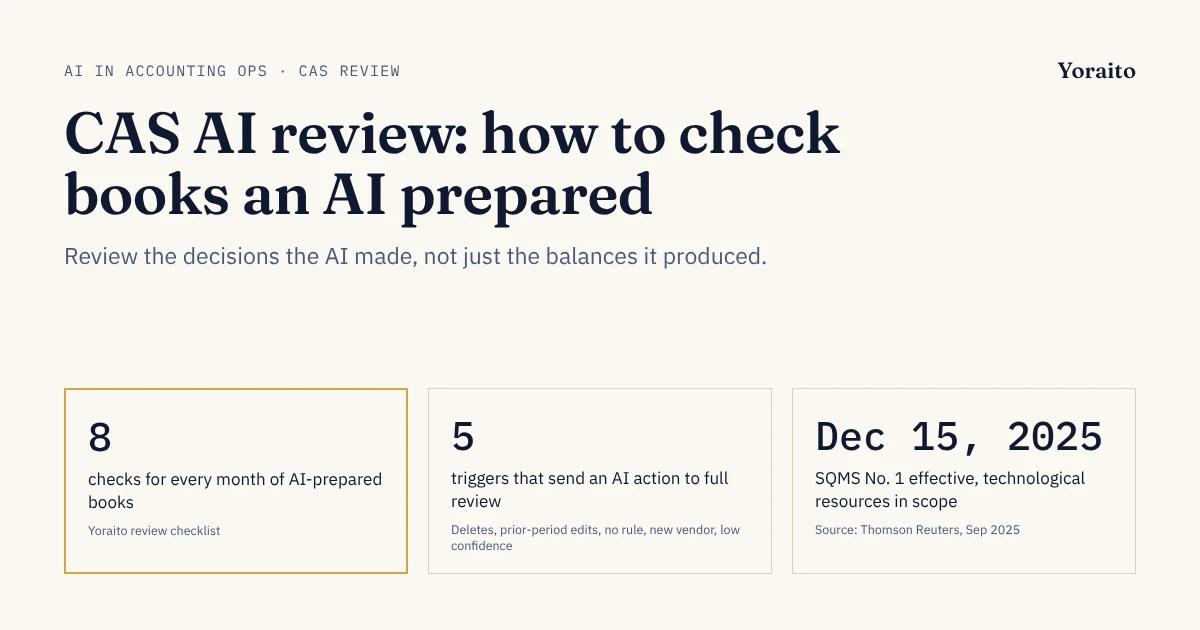
In April 2026, a client's AI agent asked for approval to fix miscategorized transactions in QuickBooks by deleting them and recreating them. The CAS advisor's answer was short: it did not need to delete anything, it needed to reclass (The CAS Cache, April 8, 2026). That is the whole CAS AI review problem in one exchange: the books can end up looking right while the method that got them there is wrong.
TL;DR: A CAS AI review checks the decisions an AI made, not just the balances it produced. Tie the source data, read the rule behind each categorization, route low-confidence and unusual items to a person, review every deletion and prior-period edit, and keep the evidence. Sample the routine work; review the risky actions in full.
What changes when AI prepares the books?
AI-prepared books are a general ledger where software made the first-pass decisions (categorizing, matching, coding, sometimes posting) and a person reviews them afterward. The work shifts from doing to reviewing. CPA.com describes it this way: systems "flag transactions based on confidence thresholds, inviting accountants to act as reviewers, not doers" (CPA.com 2025 AI in Accounting Report).
Three things change for the reviewer:
- Volume: the AI touches every transaction, so a review that reads every line takes as long as doing the work by hand.
- Method risk: a clean trial balance can hide a bad method, such as deleted-and-recreated transactions, edits to closed periods, or a rule that was right last month and wrong this month.
- Context: the AI can tell you what changed. As the same CAS Cache issue puts it, tools "still have a much harder time explaining why it happened and what should happen next."
None of this removes the reviewer's responsibility. A January 2026 Journal of Accountancy article on AI in CAS says "AI is not a replacement for professional judgment" and that the practitioner and the firm "own the responsibility for the details" (Journal of Accountancy, January 2026).
What do the professional standards expect from a CAS practice?
No AICPA standard is written specifically for reviewing AI output. Three existing ones still shape the work. This is general information, not professional advice, so confirm how each applies with your firm's quality management lead.
- SQMS No. 1 (quality management): effective December 15, 2025. It "applies broadly to firms performing audits, reviews, compilations, preparations, and attestation engagements," and its resources component now extends to "technological, intellectual, and other service providers" (Thomson Reuters, September 2025). An AI tool your team relies on is one of those resources.
- AR-C 70 (preparation of financial statements): when a firm prepares financial statements under AR-C 70, no assurance is provided, and each page needs a statement that "no assurance is provided" or a disclaimer (Carr, Riggs & Ingram explainer).
- SSARS No. 27 (March 2025): clarifies that a CPA is not required to apply AR-C 70 "when the preparation of financial statements is not the primary objective" of a consulting services engagement, though the CPA is "not precluded from applying AR-C section 70, in whole or in part" (AICPA, March 31, 2025).
Whichever standard applies, the review evidence below is what lets the practice show it understood and stood behind the numbers before they went to the client.
What should a CAS reviewer check in AI-prepared books?
A CAS AI review is a monthly check that each AI decision in a client's books had complete source data, a stated rule, the right level of human review and a retained record. Use these eight checks. For each one, ask for the evidence and know the red flag.
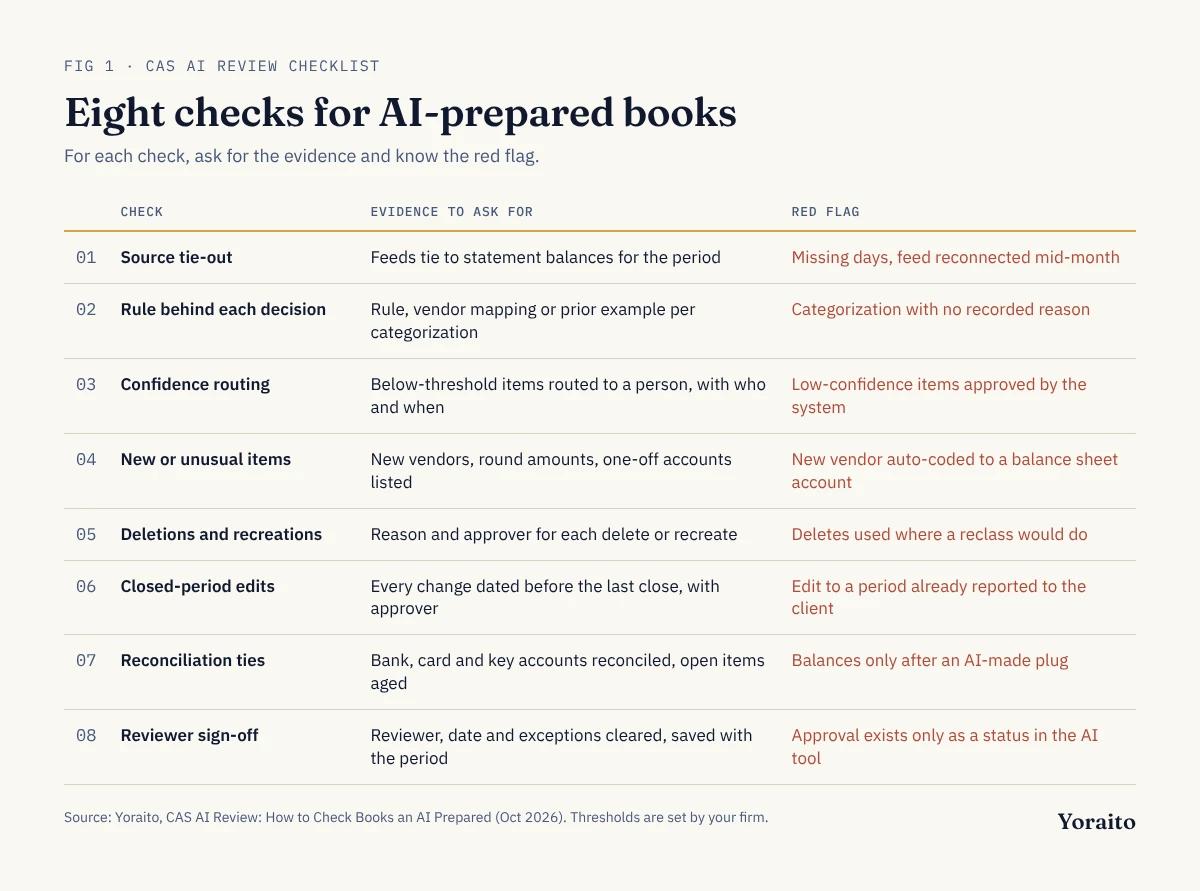
- Source tie-out: bank and card feeds tie to statement balances for the period; red flag: missing days or a feed that was reconnected mid-month.
- Rule behind each decision: every categorization shows the rule, vendor mapping or prior example it used; red flag: a categorization with no recorded reason.
- Confidence routing: items below the firm's threshold went to a person, with who and when; red flag: low-confidence items marked approved by the system.
- New or unusual items: new vendors, round amounts and one-off accounts are listed for review; red flag: a new vendor auto-coded to a balance sheet account.
- Deletions and recreations: every deleted or recreated transaction has a reason and an approver; red flag: deletes used where a reclass would do.
- Closed-period edits: any change dated before the last close is listed with its approver; red flag: an edit to a period already reported to the client.
- Reconciliation ties: bank, card and key balance sheet accounts reconcile, with open items aged; red flag: a reconciliation that balances only after an AI-made plug.
- Reviewer sign-off: the reviewer, the date and the exceptions cleared are saved with the period; red flag: approval exists only as a status in the AI tool.
The Journal of Accountancy piece makes the same point in one line: "Implement review steps to catch categorization errors or misunderstood context." Our AI audit trail checklist lists the fields each AI action should record so these checks have something to read.
Want every AI-prepared entry to arrive with the source rows, the rule and the SQL behind it, so your reviewer can re-run it? Join the Yoraito waitlist for early access.
How do you review AI decisions without reading every transaction?
Split the period's AI actions into two groups. Review the risky ones in full and sample the rest. Full review covers deletions, recreations, prior-period changes, actions with no recorded rule, new vendors and anything below your confidence threshold. Routine, high-confidence categorizations from known vendors get a sample.
If the client's tool exports an action log, one query does the split. The 0.90 threshold and the column names here are examples; use your firm's thresholds and the tool's real export fields.
-- CAS AI review: October actions that need full review
SELECT
a.action_id,
a.txn_id,
a.action_type,
a.account_before,
a.account_after,
a.amount,
a.confidence,
a.rule_id,
CASE
WHEN a.action_type IN ('delete', 'recreate') THEN 'deleted or recreated'
WHEN t.txn_date < '2026-10-01' THEN 'prior-period change'
WHEN a.rule_id IS NULL THEN 'no rule recorded'
WHEN v.first_seen_date >= '2026-10-01' THEN 'new vendor'
WHEN a.confidence < 0.90 THEN 'below threshold'
END AS review_reason
FROM ai_action_log a
JOIN transactions t ON t.txn_id = a.txn_id
LEFT JOIN vendors v ON v.vendor_id = t.vendor_id
WHERE a.acted_at >= '2026-10-01'
AND a.acted_at < '2026-11-01'
AND (
a.action_type IN ('delete', 'recreate')
OR t.txn_date < '2026-10-01'
OR a.rule_id IS NULL
OR v.first_seen_date >= '2026-10-01'
OR a.confidence < 0.90
)
ORDER BY review_reason, a.amount DESC;
Everything this query returns gets a reviewer's eyes. Everything it leaves out is the population you sample from. Save the query, its result and the date with the period's workpapers so the next reviewer can re-run it and get the same list. Our post on human-in-the-loop review thresholds covers how to set the thresholds by amount, account and confidence.
How should a CAS practice run this across many clients?
Consistency matters more than depth when one reviewer covers twenty clients. Run the same four stages every month and keep the same evidence pack for each client.
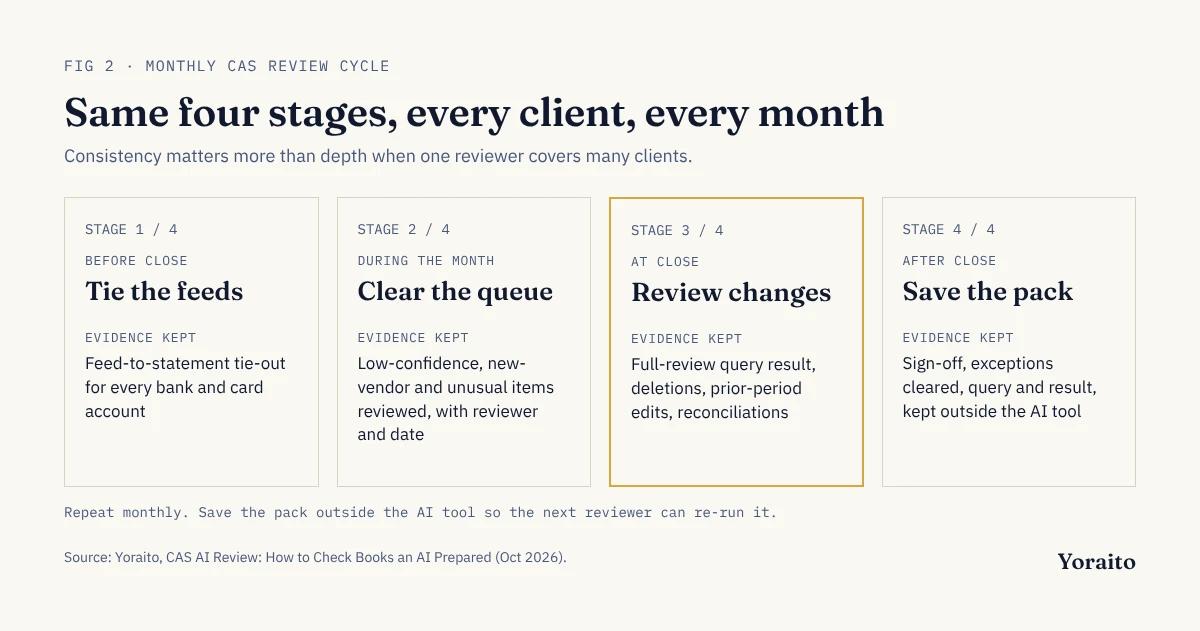
- Before close, tie the feeds: feed-to-statement tie-out for every bank and card account.
- During the month, clear the queue: low-confidence, new-vendor and unusual items reviewed, with reviewer and date.
- At close, review changes: the full-review query result, deletions, prior-period edits and reconciliations.
- After close, save the pack: sign-off, exceptions cleared, query and result, kept outside the AI tool.
Measure what the review costs, not just what the AI saves. The Journal of Accountancy article advises firms to "measure time savings and added review time, error reduction, and client feedback before expanding." If added review time eats the savings on a client, the fix is usually better rules or cleaner feeds, not less review.
What should you ask about the client's AI tool?
Many CAS clients pick their own tools, so the reviewer inherits whatever the AI records. Ask four questions before you rely on it:
- Can it export a log of every action, with the rule, confidence and timestamp?
- Does it reclass, or does it delete and recreate?
- Can it be blocked from editing closed periods?
- Does the vendor have a SOC 1 or SOC 2 report covering the service?
For longer lists, see our 12 audit trail questions for AI accounting software and what to ask AI vendors about SOC reports. If the client is moving from AI bookkeeping toward an AI-run close, AI bookkeeping vs an AI close explains what changes for the reviewer.
Where does Yoraito fit?
Yoraito is SQL-first, auditable AI for finance teams: bank reconciliation, invoice processing, Excel automation, compliance checks and the financial close. It is built so that each number the AI produces comes with the source rows, the rule and the SQL behind it, which is the evidence a CAS reviewer needs to re-run a decision instead of trusting it. Yoraito is in early access through a waitlist.
FAQ
What is a CAS AI review?
A CAS AI review is the monthly check a client advisory services team runs on books an AI helped prepare. It confirms each AI decision had complete source data, a stated rule, the right level of human review and a saved record, rather than only checking that balances look right.
Do CPAs have to review every AI-categorized transaction?
No standard requires a line-by-line review. A practical approach is to review high-risk actions in full (deletions, prior-period edits, new vendors, low-confidence items, anything with no recorded rule) and sample routine, high-confidence categorizations. Document the split and the sample.
Does SQMS No. 1 cover AI tools used by a CAS practice?
SQMS No. 1 took effect December 15, 2025, and its resources component includes technological resources. An AI tool the firm relies on to perform preparation or compilation work falls under that. Confirm the scope for your firm with your quality management lead.
Does AR-C 70 apply when AI prepares a client's financial statements?
AR-C 70 depends on what the client engaged the firm to do, not on who or what did the work. SSARS No. 27 clarifies it is not required when financial statement preparation is not the primary objective of a consulting engagement. Use the AICPA's guidance to decide each engagement.
What is the biggest red flag in AI-prepared books?
Deleted and recreated transactions, or edits to closed periods, with no recorded reason or approver. Both can leave a clean trial balance while breaking the audit trail behind it.
What is the next step?
Pick one client whose books an AI helps prepare. Export the October action log, run the full-review query, and walk the eight checks with the result. Note how long the review took and which checks the tool could not answer. That gap list is your first conversation with the client about their setup. To hear when Yoraito opens up, join the waitlist.