
Human in the Loop Finance AI: Setting Review Thresholds
How to set human-in-the-loop review thresholds for finance AI by amount, account risk and model confidence, with a routing matrix, a SQL rule your auditor can replay and a monthly calibration checklist.
Reviewing every AI output defeats the point of automating the work. Reviewing none of it fails the first audit question. The fix is a written threshold that says which AI outputs a person must approve, set by amount, account and confidence.
TL;DR: Human in the loop finance AI means a named person approves any AI output that crosses a written threshold before it reaches the ledger. Set thresholds on three axes: amount relative to materiality, account risk and model confidence. Route on the strictest axis, log every decision and recalibrate monthly from reviewer overrides.
What does human in the loop mean for finance AI?
Human in the loop (HITL) for finance AI is a control design in which AI prepares the work and a named person approves any output that crosses a predefined threshold before it posts. The threshold is the part most teams skip. Without it, "human in the loop" means either everyone reviews everything or nobody is sure who reviewed what.
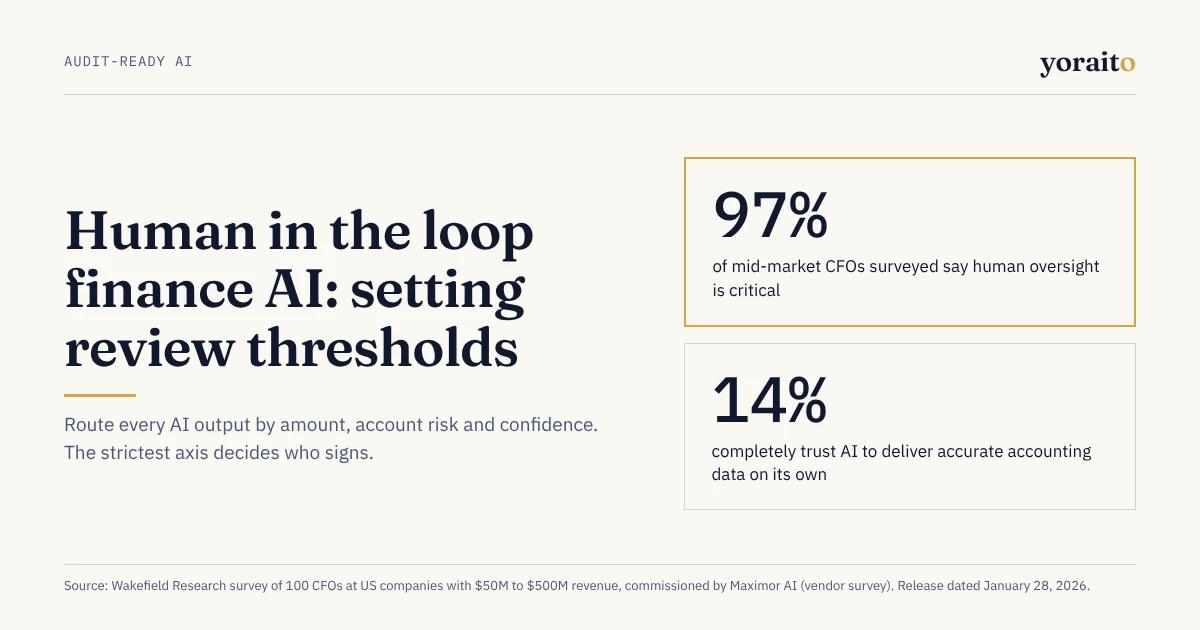
Finance leaders say they want the human there. In a vendor-commissioned survey by Wakefield Research for Maximor AI of 100 CFOs at mid-market US companies ($50M to $500M revenue), 97% said human oversight is critical, and only 14% said they completely trust AI to deliver accurate accounting data on its own (Maximor AI release, January 28, 2026). CFO Dive's coverage of the same survey adds that 86% of respondents said their finance team had encountered at least one instance of inaccurate or "hallucinated" data.
It helps to name the three positions a person can hold:
- In the loop: a person approves the output before it posts. Use it for high-risk or high-value items.
- On the loop: AI posts, and a person samples and monitors afterwards. Use it for low-risk, high-volume items with clear right answers.
- Out of the loop: nobody looks. In financial reporting, no AI workflow you run should fit this description.
Why not review everything, or nothing?
Reviewing everything sounds safe, but it fails quietly. A reviewer who approves hundreds of routine coding suggestions a day stops reading them, and the approval log ends up proving attendance rather than review. You also lose the time savings that justified the tool.
Reviewing nothing fails loudly. COSO's February 2026 publication on internal control over generative AI, as summarized by Deloitte, tells companies to "apply a use-case-based decision framework to right-size the level of human involvement" based on "the risk profile of each use case." It also says financially relevant outputs should "receive appropriate human oversight and are supported by appropriate evidence."
Auditors already have a vocabulary for this. PCAOB Staff Audit Practice Alert No. 11 lists criteria for investigation among the factors that set a review control's precision: "For detective controls, the threshold for investigating deviations or differences from expectations relative to materiality is an indication of a control's precision." A control that only investigates items near materiality, the alert says, has less precision and "a greater risk of failing to prevent or detect misstatements that could be material."
In other words, your AI review threshold is not an internal preference. It is part of a control design an auditor will evaluate.
How do you set review thresholds by amount, account and confidence?
Use three axes, and let the strictest one decide.
1. Amount, relative to materiality. Set dollar bands from your materiality figures, not from round numbers someone picked in a meeting. A workable structure has a floor, below which items can auto-post with sampling, and an upper band, above which two people sign. Keep the upper band well below performance materiality, for the precision reason above, and agree the figures with your auditor before year-end.
2. Account risk. Tier your chart of accounts once:
- Tier 1, high risk: cash, revenue, equity, reserves and other estimates, related-party balances. AI output here never auto-posts.
- Tier 2, judgment: accruals, prepaids, payroll allocations, fixed assets.
- Tier 3, routine: recurring vendor bills, bank fees, standard expense coding.
3. Model confidence, treated with suspicion. A confidence score is only useful once it has been checked against what reviewers actually changed. A safer signal is the type of match: an exact rule match is different from a fuzzy or first-time match. Treat new vendors, new accounts and unfamiliar descriptions as low confidence, whatever the score says.
Here is how the three axes combine into one routing matrix. The floor and upper band are placeholders for your own materiality-based figures, not benchmarks.
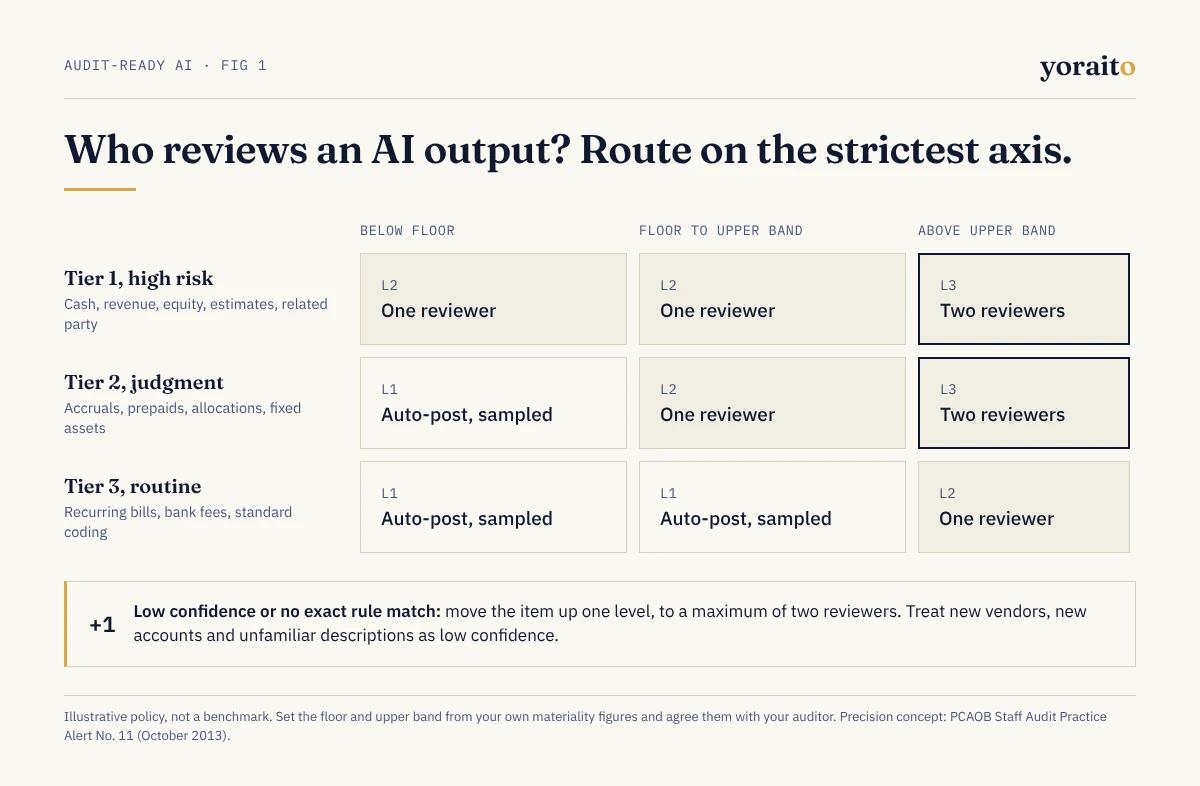
- Tier 1 (cash, revenue, equity, estimates): below floor, one reviewer; floor to upper band, one reviewer; above upper band, two reviewers.
- Tier 2 (accruals, prepaids, allocations): below floor, auto-post with sampling; floor to upper band, one reviewer; above upper band, two reviewers.
- Tier 3 (routine coding, bank fees): below floor, auto-post with sampling; floor to upper band, auto-post with sampling; above upper band, one reviewer.
- Low confidence or no exact rule match: move the item up one level, to a maximum of two reviewers.
Want every AI proposal to arrive with its route, the threshold that set it and the rows behind it? Join the Yoraito waitlist for early access.
What does a threshold rule look like in practice?
Write the thresholds into a table, not into a reviewer's memory. Routing then becomes a query anyone can rerun:
-- Route each AI proposal using the written threshold policy
-- review_level: 1 = auto-post (sampled), 2 = one reviewer, 3 = two reviewers
WITH scored AS (
SELECT
p.proposal_id,
p.amount,
p.confidence,
a.risk_tier,
m.base_level,
CASE WHEN p.confidence < t.min_confidence
OR p.match_type <> 'exact_rule' THEN 1 ELSE 0 END AS escalate,
t.policy_version
FROM ai_proposals p
JOIN accounts a ON a.account_id = p.account_id
JOIN review_thresholds t ON t.risk_tier = a.risk_tier
JOIN review_matrix m ON m.risk_tier = a.risk_tier
AND ABS(p.amount) >= m.amount_from
AND ABS(p.amount) < m.amount_to
WHERE p.period = '2026-10'
)
SELECT proposal_id, amount, confidence, risk_tier,
LEAST(base_level + escalate, 3) AS review_level,
policy_version
FROM scored;
Two details matter to an auditor. The bands and the confidence cutoff live in tables with a policy version, so changing a threshold is itself a dated, approved change. And because routing is a query over stored data, last month's routing can be replayed to show that every item went where the policy said it should.
How do you know the thresholds are right?
Thresholds are a starting guess. Calibrate them every month from evidence already in the review log:
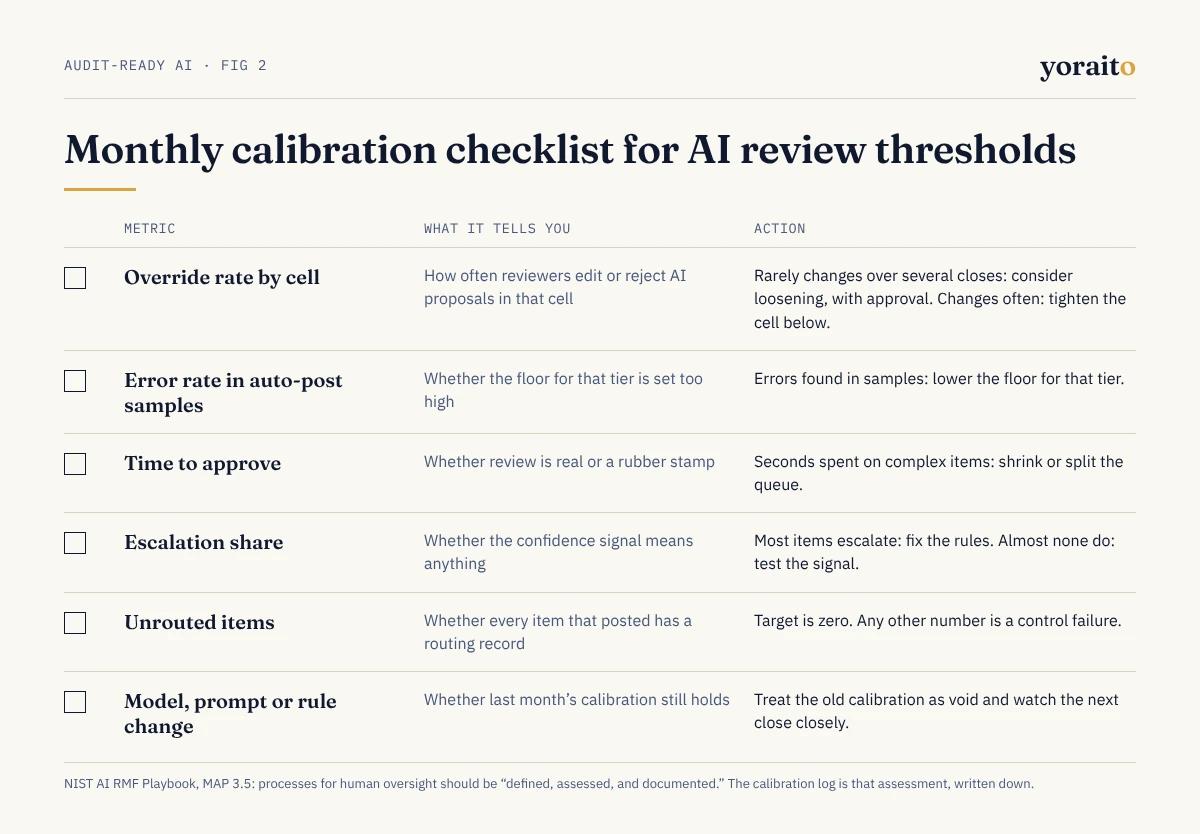
- Override rate by cell: the share of AI proposals reviewers edited or rejected. If a reviewed cell rarely changes anything over several closes, you may be able to loosen it, with documented approval. If it changes a lot, tighten the cell below it.
- Error rate in auto-post samples: if samples from an auto-post cell turn up errors, lower the floor for that tier.
- Time to approve: approvals that take seconds on complex items suggest rubber-stamping. Shrink or split the queue.
- Escalation share: if most items escalate on confidence, the rules need work. If almost none do, check that the confidence signal means anything.
- Unrouted items: anything that reached the ledger without a routing record. This number must be zero.
- Model, prompt or rule changes: treat the old calibration as void and watch the next close closely.
NIST's AI Risk Management Framework makes the same point in general terms: processes for human oversight should be "defined, assessed, and documented" (NIST AI RMF Playbook, MAP 3.5). Your calibration log is that assessment, written down.
What should each review decision record?
Every routed item should leave a record that answers the auditor's questions without a meeting:
- The proposal ID and the source rows it was built from
- The rule, prompt or model version that produced it
- The confidence score and match type
- The route assigned and the policy version that assigned it
- The reviewer, the decision (approve, edit or reject) and what changed
- The timestamp, and the posted entry ID if it posted
The full field set is in our AI audit trail checklist. For journal entries, AI journal review needs governance, not just automation covers keeping preparer and approver separate. If you are testing a tool now, add threshold routing as a scored line in your 30-day AI accounting pilot scorecard. If your team is still uneasy about AI touching the books at all, read why finance teams are still wary of giving AI control alongside this one.
FAQ
What is human in the loop in finance AI?
It is a control design where AI prepares work such as matches, codings or draft entries, and a named person approves outputs that cross a defined threshold before they reach the ledger. Lower-risk items can post with sampling.
Does every AI-generated journal entry need human review?
Not every one, but every one needs a rule that decides. Entries to high-risk accounts or above your dollar threshold should be approved before posting. Routine, low-value entries can post with after-the-fact sampling if the routing is documented.
How do you set a confidence threshold for accounting AI?
Start with a conservative cutoff, then calibrate it against reviewer overrides over several closes. Treat first-time vendors, new accounts and fuzzy matches as low confidence regardless of the score.
What is the difference between human in the loop and human on the loop?
In the loop means a person approves before the output posts. On the loop means the output posts and a person monitors and samples afterwards. Most finance teams need both, assigned by risk.
Will auditors accept AI outputs approved automatically below a threshold?
They evaluate the control, not the label. PCAOB staff guidance treats the threshold for investigation as an indicator of a review control's precision, so expect questions about how you set it, whether it was followed and how the auto-posted population was sampled.
What is the next step?
Pick one AI workflow, write down the thresholds you use today, including the unwritten ones, and run last month's proposals through the matrix to see how many land in each cell. That count is the first entry in your calibration log. To hear when Yoraito opens up, join the waitlist.