
AI ROI for Small Finance Teams: A Business Case Template
A business case template for small finance teams: the seven measures to take before buying AI, and why net hours saved after review decides the ROI.
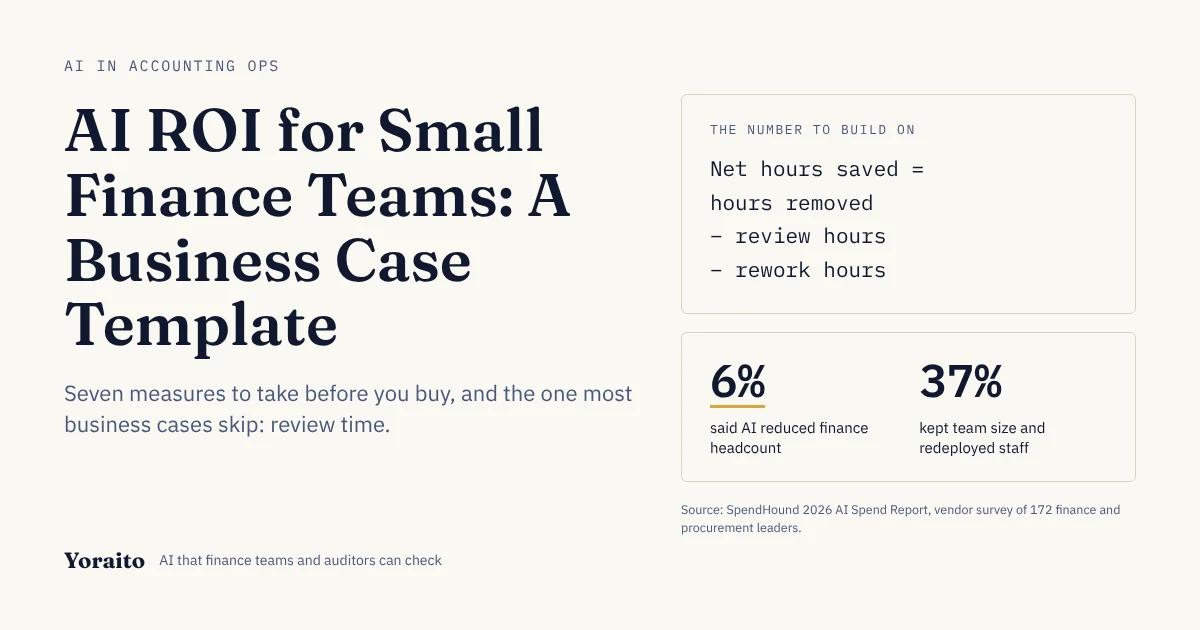
A four-person finance team can't pay for AI by cutting a head, so most AI ROI templates don't fit it. The business case that holds up is built from hours, exceptions and rework, and it subtracts the time someone spends checking the AI's work.
TL;DR: To build an AI business case for a small finance team, measure one workflow before you buy: hours per month, items, review minutes per item, exception rate, rework and outside spend. Value the tool on net hours saved after review and rework, not on preparation time. If the controller re-checks every output, the case can turn negative.
Why don't most AI ROI templates fit a small finance team?
Most published AI ROI examples assume enterprise volumes: thousands of invoices a month, a six-figure platform and a headcount line to cut. A team of three to eight people rarely has any of those. It has a controller who is also the main reviewer, a close that runs on a few people's evenings, and a hiring plan it would like to push back.
The survey data points the same way. In SpendHound's 2026 AI Spend Report, a vendor survey of 172 finance and procurement leaders, only 6% said AI had reduced finance headcount, while 37% said teams stayed the same size and people moved to higher-value work. For a small team, the return usually shows up as capacity, not as payroll savings.
The pressure to prove a return is high anyway. Avalara's survey of 1,505 CFOs and senior finance executives, also vendor-run, found that 92% feel pressure to show that AI investment yields a decent return, and half said their AI agents had produced only limited measurable ROI. Gartner reported in May 2026 that 63% of finance organizations said AI implementation was slower than expected in 2025.
Net hours saved is the hours an AI tool removes from a workflow, minus the hours your team spends reviewing its output and fixing what it got wrong.
That is the number a small-team business case should rest on. We covered why review time eats AI savings in AI in finance ROI: why spend is up and results aren't. This post is the worksheet.
What should a small finance team measure before buying AI?
Pick one workflow, such as bank reconciliation or AP invoice coding, and measure it for two weeks before any vendor call. Seven measures cover the business case:
- Baseline hours: time logs or a two-week time sample for everyone who touches the workflow; hours per month.
- Volume: items processed per month, such as bank lines, invoices or journal entries; count.
- Review minutes per item: time the reviewer spends checking each item, logged apart from preparation; minutes.
- Exception rate and age: share of items that need a person, and how long they wait; percent and days.
- Rework: entries corrected or reversed after posting, and the hours to fix them; count and hours.
- Close days: business days from period end to sign-off, counted the same way before and after; days.
- Outside spend: overtime, temps, outsourced bookkeeping hours and audit prep help tied to this workflow; dollars per month.
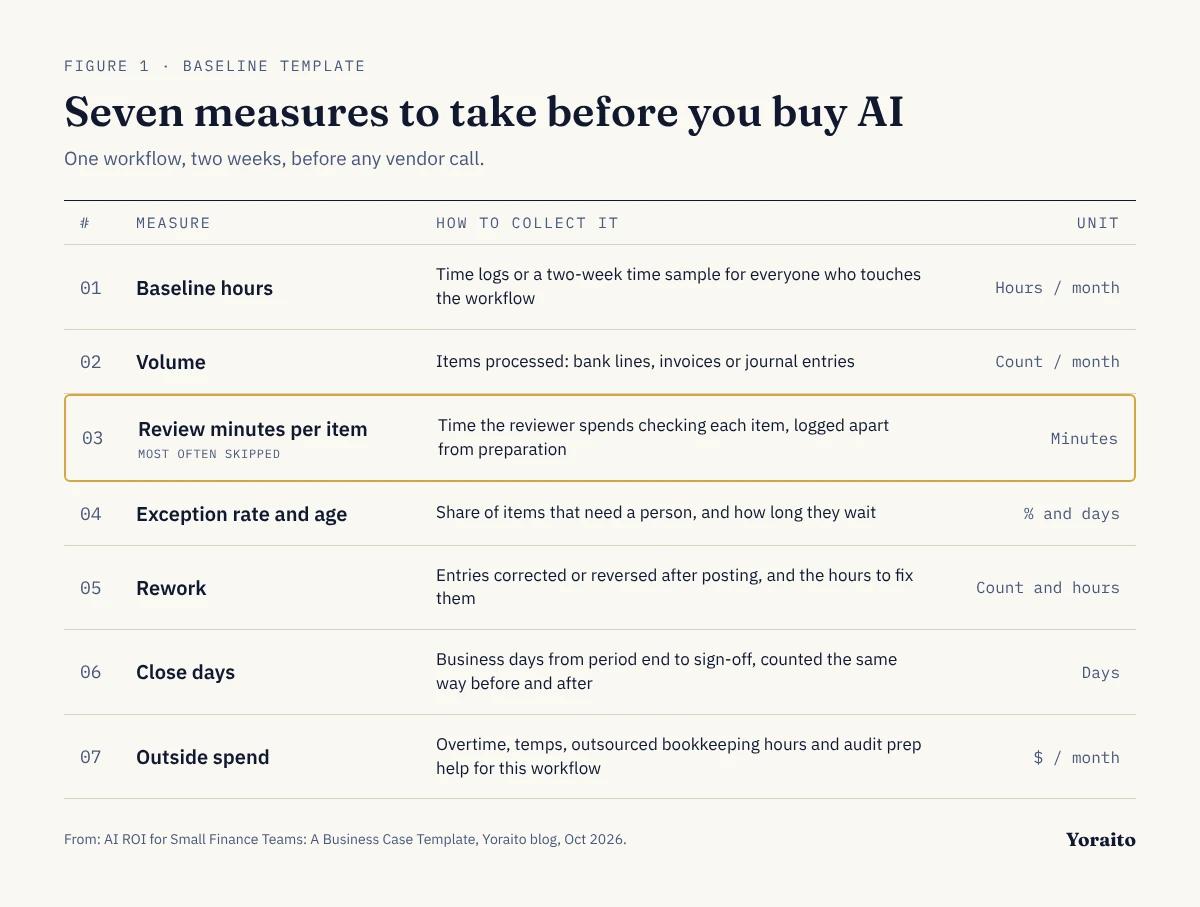
Review minutes per item is the measure most business cases skip, and on a small team it matters most, because the reviewer is usually the controller. An hour of the controller's review time costs more than an hour of preparation, and it comes out of the same week as the close.
Log these against the workflow, not the person. If you later run a pilot, the same baseline becomes your starting point; our 30-day AI accounting pilot scorecard picks up from here.
How do you turn those measures into a business case?
Use three lines and keep them separate:
- Net hours saved per month = baseline hours - AI-era preparation hours - review hours - rework hours
- Net monthly value = net hours saved x your loaded hourly rate + outside spend avoided - monthly tool cost
- Payback in months = one-time setup cost / net monthly value
The worked example below uses illustrative numbers, not benchmarks and not Yoraito pricing. A four-person team spends 60 hours a month on bank reconciliation and AP coding across 600 items. With an AI tool, preparation falls to 15 hours and rework stays at 2 hours. The tool costs $1,500 a month plus $6,000 to set up, and the loaded rate is $75 an hour. Outside spend avoided is left at zero to keep it simple.
The only thing that changes between the two scenarios is how the controller reviews:
- Baseline hours: A, 60; B, 60
- AI-era preparation hours: A, 15; B, 15
- Review hours: A, every item re-checked, 600 x 3 min = 30; B, 60-item sample at 3 min plus 45 exceptions at 6 min = 7.5
- Rework hours: A, 2; B, 2
- Net hours saved: A, 13; B, 35.5
- Value at $75 an hour: A, $975; B, $2,662.50
- Less monthly tool cost: A, -$1,500; B, -$1,500
- Net monthly value: A, -$525; B, $1,162.50
- Payback on $6,000 setup: A, none; B, about 5.2 months
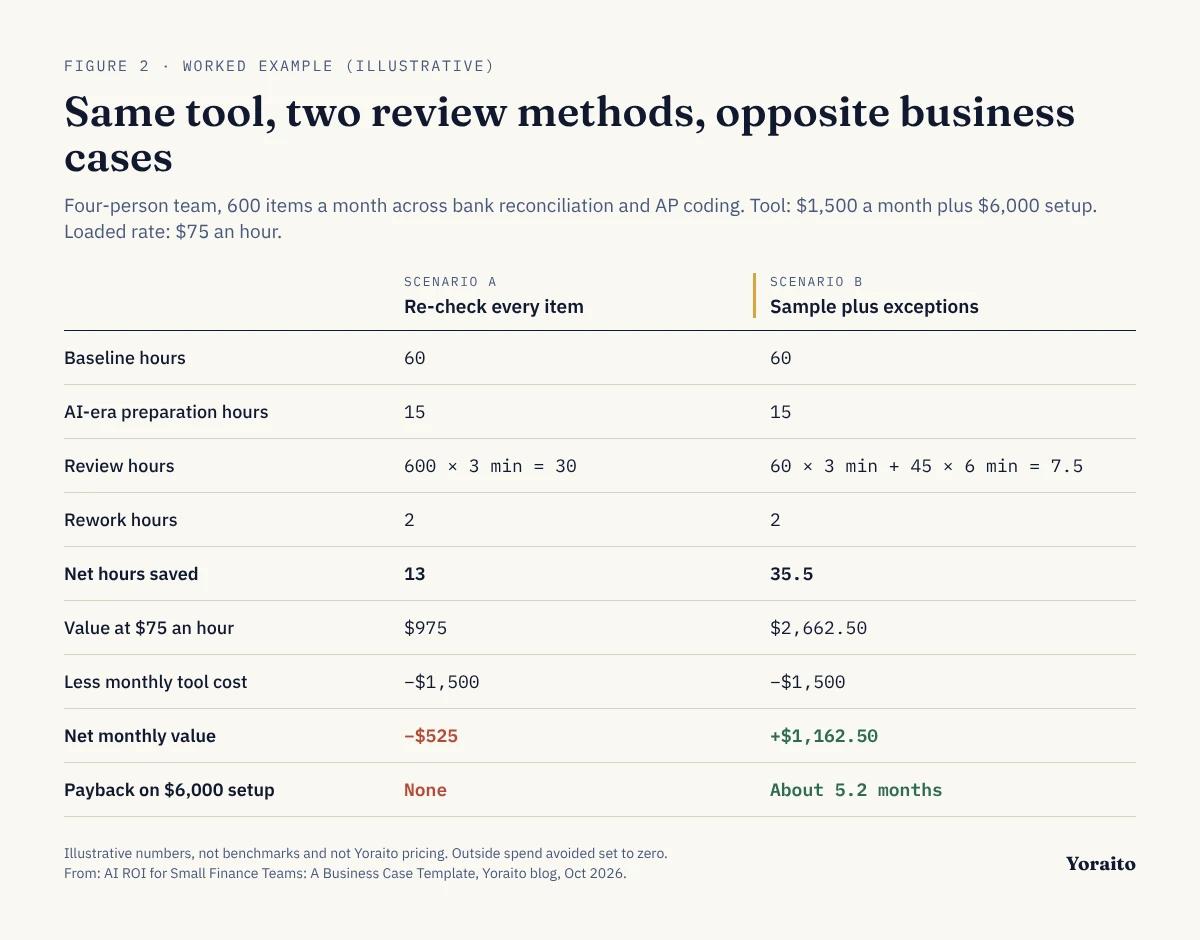
Same tool, same preparation time, same rework. In scenario A the controller can't see how each output was produced, so they check all of it, and the business case goes negative. In scenario B every output shows the source rows and the rule behind it, so the controller tests a sample and works the exceptions. That is the difference between a tool that saves time and one that moves time into review.
On a small team, the review method decides AI ROI more than the tool's preparation speed does.
A sample-and-exceptions review only holds up if each item can be traced. For the record each AI action should keep, see the AI audit trail checklist.
Want every match to come with the source rows, the rule and the SQL behind it? Join the Yoraito waitlist for early access.
How do you measure review time without a time-tracking project?
You don't need new software. If your team logs work against tasks, or you add a start and end time to each task during the two-week sample, the measures fall out of one query. An illustrative version:
-- Net hours saved for one workflow, by month
-- 60 = baseline hours from your pre-AI time sample
SELECT
period,
SUM(CASE WHEN activity = 'prep' THEN minutes ELSE 0 END) / 60.0 AS prep_hours,
SUM(CASE WHEN activity = 'review' THEN minutes ELSE 0 END) / 60.0 AS review_hours,
SUM(CASE WHEN activity = 'rework' THEN minutes ELSE 0 END) / 60.0 AS rework_hours,
60 - SUM(minutes) / 60.0 AS net_hours_saved
FROM time_log
WHERE workflow = 'bank_rec_ap_coding'
AND activity IN ('prep', 'review', 'rework')
GROUP BY period
ORDER BY period;
The table and column names are placeholders. Run it after each close. If review hours don't fall after the first two closes, the tool isn't saving time yet, whatever its preparation numbers say. The same logic applies to matching: a reviewer can only sample a bank rec when every match explains itself.
What belongs in the business case besides hours?
Some benefits are real but hard to price. List them, and keep them out of the payback math so the hard number stays defensible:
- Capacity: volume growth you can absorb before the next finance hire. For many VC-backed teams this is the main reason to buy.
- Close days: fewer days from period end to sign-off, measured the same way each month.
- Audit evidence: whether your auditor can test the AI's work from the record. In Avalara's survey, 44% were only somewhat confident they could explain an AI agent's actions to an auditor or regulator, and only 28% required documented audit logs showing how the agent reaches its decisions.
- Key-person risk: whether the workflow still runs when the one person who knows it is out.
What should you leave out of the business case?
- Headcount cuts you don't plan to make. If no role goes away, don't count a salary.
- Vendor ROI benchmarks. Multiples quoted without a named survey and sample won't survive your CFO's first question.
- Preparation time on its own. Without review and rework, it overstates the gain.
- Unpriced "insight". If you can't say which decision changes, it isn't a line in the case.
Gartner's Marco Steecker put the bar plainly: "Finance does not need to prove that it can use AI anymore. It needs to prove that AI can change how finance supports better business decisions." For a small team, the first proof is simpler: net hours that come back every month, measured the same way. For more survey data in one place, see our 2026 roundup on trust in finance AI.
Where does Yoraito fit?
Yoraito is built SQL-first so that review can be a sample, not a re-check. Each automated step, such as a reconciliation match or a compliance check, is SQL your team and your auditor can read and rerun, and reviewer approvals are recorded against the items they cover. That is what scenario B depends on.
Frequently asked questions
How do you calculate AI ROI for a finance team?
Measure one workflow before and after. Net hours saved equals baseline hours minus AI-era preparation, review and rework hours. Multiply by your loaded hourly rate, add outside spend avoided, and subtract the monthly tool cost. Divide the one-time setup cost by that net monthly value to get payback in months.
Is AI worth it for a small finance team?
It can be, but rarely through headcount. In SpendHound's 2026 vendor survey, 6% said AI reduced finance headcount and 37% said staff were redeployed. For a small team the return is usually capacity and close days, and it only holds if review time per item falls.
What is the biggest hidden cost of AI in accounting?
Review time. If a reviewer can't see how an output was produced, they check every item, and the hours saved on preparation move into review. Track review minutes per item separately from preparation time from the first month.
How long should payback on AI take for a finance team?
There is no reliable public benchmark, so agree a threshold with your CFO before you buy. Calculate payback as one-time setup cost divided by net monthly value, using your own baseline. If net monthly value is zero or negative, there is no payback, whatever a vendor's average says.
What should you do before your next vendor call?
Pick one workflow and run the two-week time sample. Fill in the seven measures, then run both review scenarios: re-check everything, and sample plus exceptions. If the case only works with sampling, ask each vendor to show you, on your own data, what a reviewer sees for a single item. To hear when Yoraito opens up, join the waitlist.