
10 AI Use Cases in Accounting and What Auditors Need
Ten AI use cases in accounting, from bank reconciliation to contract abstraction, and the evidence your auditor needs for each: complete inputs, logic they can re-perform and a named reviewer.
Most lists of AI use cases in accounting stop at what the AI does. The question that decides whether a use case survives year-end is a different one: what will your auditor ask to see for each?
TL;DR: Ten common AI use cases in accounting are bank reconciliation, invoice capture, three-way match, cash application, journal entry drafting, anomaly detection, flux commentary, policy checks, contract abstraction and Excel schedules. For each, auditors need the same three things: complete inputs, logic they can re-perform and a named human reviewer.
Which AI use cases in accounting are teams actually using?
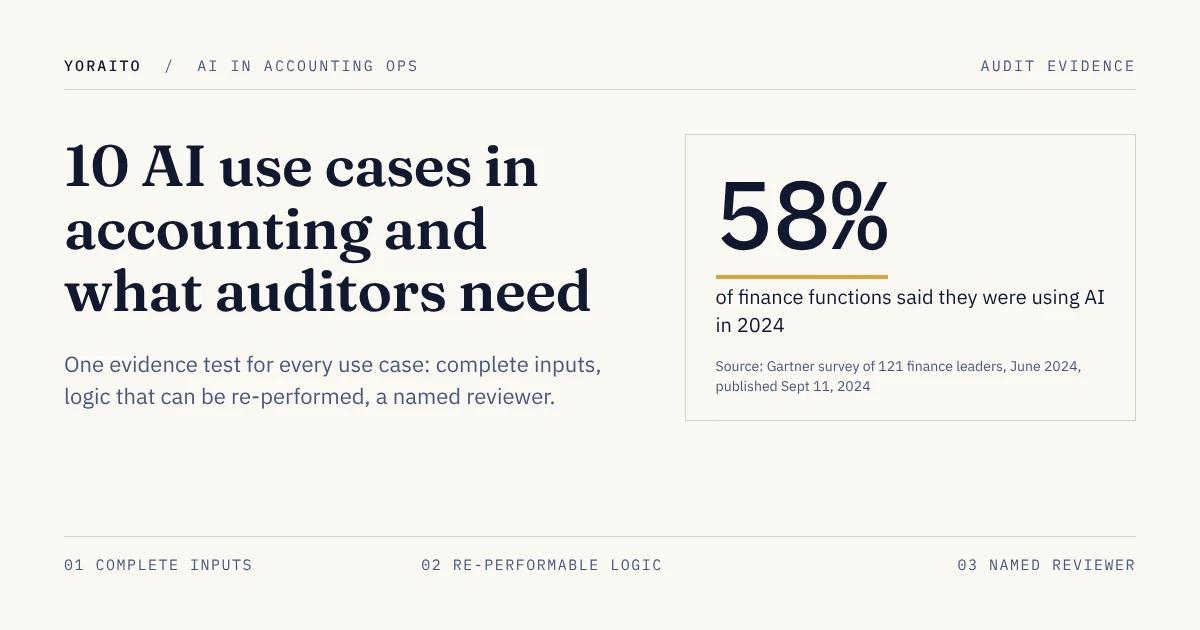
AI in finance is no longer a fringe experiment. In a Gartner survey of 121 finance leaders fielded in June 2024 and published September 11, 2024, 58% of finance functions said they were using AI. The most common uses were intelligent process automation (44%), anomaly and error detection (39%), analytics (28%) and operational assistance and augmentation (27%).
Those categories are broad. On the ground, they turn into ten specific jobs that show up in month-end close and in vendor demos:
- Bank reconciliation matching: pairing bank lines with ledger cash entries.
- Invoice capture and coding: reading vendor invoices and suggesting the GL account, department and vendor.
- Three-way match: checking an invoice against the purchase order and the receiving record.
- Cash application: matching customer payments and remittances to open invoices.
- Journal entry drafting: proposing accruals, reclasses and recurring entries for approval.
- Anomaly detection in the general ledger: flagging unusual entries across the full population.
- Flux and variance commentary: drafting explanations for month-over-month or budget-to-actual swings.
- Policy and compliance checks: testing every expense or payment against written policy.
- Contract and lease abstraction: pulling terms, dates and amounts out of agreements.
- Excel schedule automation: rolling forward prepaid, accrual and amortization workbooks.
Why does the auditor care how AI did the work?
Because the output becomes audit evidence, and audit evidence has rules. Under PCAOB AS 1105, when an auditor uses information produced by the company, the auditor must "test the accuracy and completeness of the information, or test the controls over the information," as summarized in the PCAOB's April 2024 Spotlight on data and reports. An AI-generated reconciliation is information produced by the company. If nobody can show what went in and how it was produced, the auditor has to test the result some other way, which usually means more sampling and more of your team's time.
The rules are also getting more specific about technology. The PCAOB adopted amendments to AS 1105 and AS 2301 on technology-assisted analysis in June 2024 (PCAOB Release No. 2024-007). The SEC approved them in August 2024 (NYSSCPA), and they apply to audits of fiscal years beginning on or after December 15, 2025. For a calendar-year company, that is the FY2026 audit now being planned.
On the company side, COSO published Achieving Effective Internal Control Over Generative AI in February 2026. Deloitte's summary lists "logging/traceability (model/version, prompts, key inputs/outputs, approvals)" as a control building block, and says outputs that could affect material amounts should "receive appropriate human oversight and are supported by appropriate evidence."
What is the three-part evidence test?
The three-part evidence test asks whether an AI output has complete inputs, logic someone else can re-perform, and a named human who reviewed it. If all three are present, the output can usually be relied on like any other system report. If one is missing, it gets treated like an unsupported schedule.
- Complete inputs: the auditor can see the exact data the AI used, and it ties to the source system (row counts and totals).
- Re-performable logic: the rule, prompt or model version that produced each result is recorded, so the same inputs give the same answer when rerun.
- Named reviewer: a person approved the output, with a timestamp, before it reached the ledger or the reporting pack.
We go deeper on the fields behind each of these in the AI audit trail checklist.
What evidence does each AI use case need?
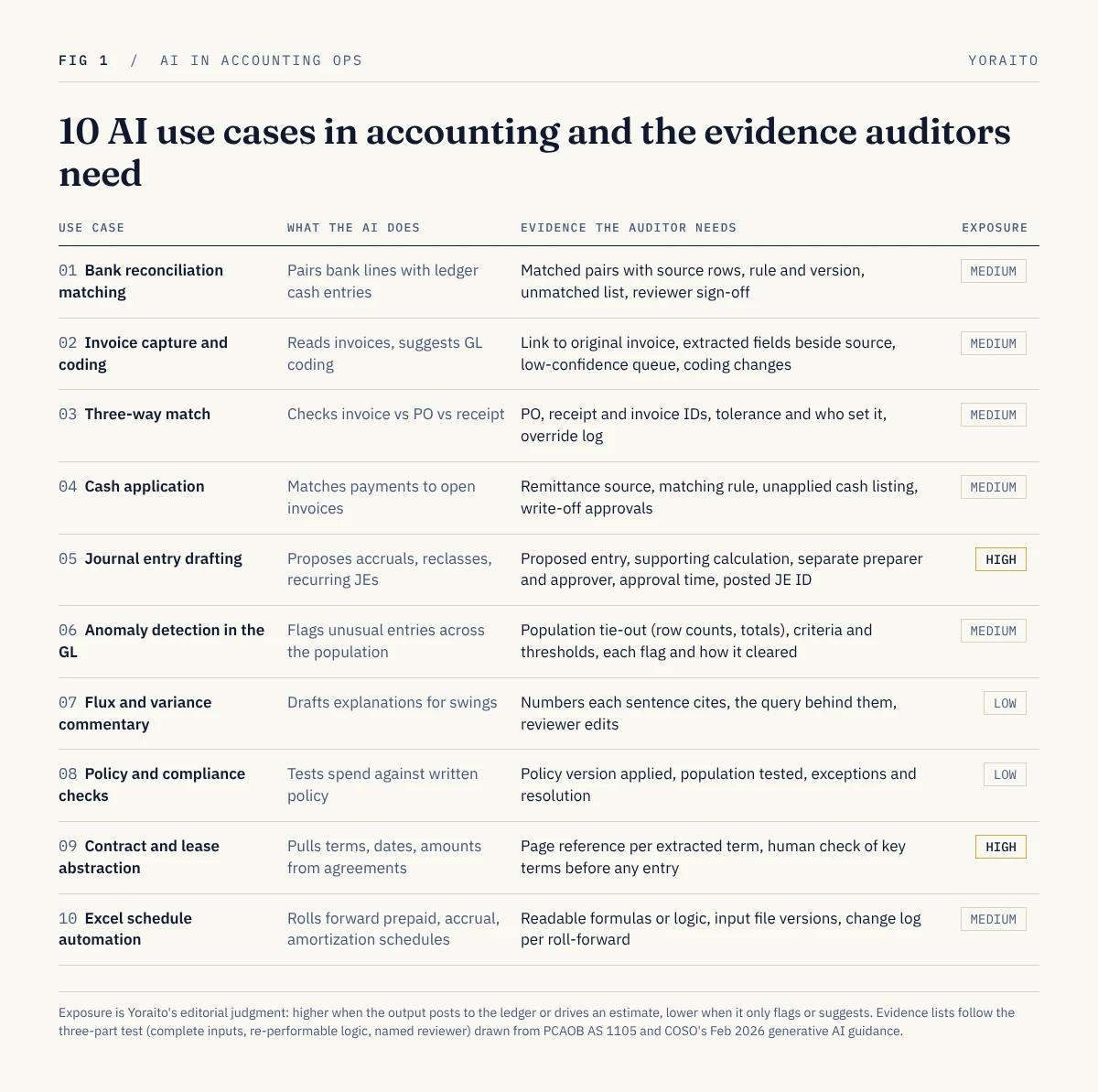
Here is the full map. "Exposure" is our judgment of how much audit scrutiny each use case tends to attract: higher when the output posts to the ledger or involves an estimate, lower when it only suggests or flags.
- Bank reconciliation matching: matched pairs with source rows, the match rule and version, the unmatched list, reviewer sign-off; exposure medium.
- Invoice capture and coding: link to the original invoice, extracted fields next to the source, low-confidence queue, who changed the coding; exposure medium.
- Three-way match: PO, receipt and invoice IDs, the tolerance used and who set it, an override log; exposure medium.
- Cash application: remittance source, the matching rule, unapplied cash listing, approvals for write-offs; exposure medium.
- Journal entry drafting: proposed entry, the supporting calculation, preparer and approver kept separate, approval timestamp, posted entry ID; exposure high.
- Anomaly detection in the GL: proof the full population was scanned (row counts and totals tie), the criteria and thresholds, each flag and how it was cleared; exposure medium.
- Flux and variance commentary: the numbers each sentence cites, the query that produced them, reviewer edits; exposure low.
- Policy and compliance checks: the policy version applied, the population tested, exceptions and how each was resolved; exposure low.
- Contract and lease abstraction: page reference for each extracted term, human verification of key terms before they drive an entry; exposure high.
- Excel schedule automation: readable formulas or logic, input file versions, a change log for each roll-forward; exposure medium.
Two patterns stand out. First, the use cases that post entries or drive estimates (journal drafting, contract abstraction) need the most evidence, because a wrong output flows straight into the numbers. Second, the evidence is mostly the same list every time. A team that builds the three-part test into one use case has most of it for the next.
Want every match and flag to come with the source rows, the rule and the SQL behind it? Join the Yoraito waitlist for early access.
How do you prove an AI reviewed the whole population?
Completeness is the evidence most often missing. An AI tool that says it "checked every journal entry" should be able to prove it with a tie-out. If the review log lives in a database, two short queries do it.
-- 1. Do the row counts and absolute totals tie?
SELECT
(SELECT COUNT(*) FROM gl_lines WHERE period = '2026-09') AS gl_rows,
(SELECT COUNT(*) FROM ai_review_log WHERE period = '2026-09') AS reviewed_rows,
(SELECT SUM(ABS(amount)) FROM gl_lines WHERE period = '2026-09') AS gl_abs_total,
(SELECT SUM(ABS(amount)) FROM ai_review_log WHERE period = '2026-09') AS reviewed_abs_total;
-- 2. Which GL lines were never reviewed?
SELECT g.line_id, g.entry_id, g.amount
FROM gl_lines g
LEFT JOIN ai_review_log r ON r.line_id = g.line_id
WHERE g.period = '2026-09'
AND r.line_id IS NULL;
If the first query returns matching pairs and the second returns zero rows, you have a one-page answer to the completeness question. Save both results with the run date, and the auditor can rerun them against the same snapshot. The same pattern works for bank lines, invoices and expense reports. We walk through the matching side in AI bank reconciliation: what every match should explain.
Which AI use cases should a lean team start with?
Start where the evidence is easiest to produce and the exposure is lowest, then move toward the ledger.
- Start with flags, not postings. Anomaly detection, policy checks and flux drafts suggest; a person decides. Errors cost review time, not restatements.
- Move to matching next. Bank reconciliation, cash application and three-way match have clear right answers that a reviewer can check line by line.
- Add drafting last. Journal entries and contract-driven estimates need the full three-part test, plus separation between the AI as preparer and a human approver. Our post on governed AI journal review covers that split.
Whichever you pick, test it the way an auditor would before you rely on it. The 30-day AI accounting pilot scorecard includes audit trail as a scored line, next to accuracy and exception rate.
What should you ask a vendor before rolling out any of these?
Five questions cover most of the three-part test:
- Can you export the exact input rows for any result, with counts that tie to our source system?
- Is the rule, prompt or model version stored with every output?
- If we rerun last month on the same inputs, do we get the same answer?
- Who approved each output, and when, and can that person be someone other than the preparer?
- Can our auditor get read access to the log without a screen share?
If the answers are vague, plan for extra audit testing. That cost belongs in the business case. For year-end timing, the PBC list reconciliation guide shows what auditors ask for and when.
FAQ
What is the most common AI use case in accounting?
In Gartner's 2024 survey of finance functions, intelligent process automation was the most common use (44%), followed by anomaly and error detection (39%). In practice that means matching, data capture and exception flagging.
Will auditors accept work done by AI?
Auditors evaluate AI output like any other information produced by the company. Under PCAOB AS 1105 they test its accuracy and completeness, or the controls over it. Output with complete inputs, re-performable logic and a named reviewer is far easier to rely on.
Does AI replace the reviewer in accounting?
No. COSO's 2026 generative AI guidance, as summarized by Deloitte, says outputs that could affect material amounts should receive appropriate human oversight. AI can prepare; a person still approves.
What should an AI audit trail record?
At minimum: the inputs used, the rule or model version, the output, who reviewed it and when. COSO's guidance, as summarized by Deloitte, lists model/version, prompts, key inputs and outputs, and approvals as logging and traceability building blocks.
What is the next step?
Pick one use case from the table, run the three-part evidence test on it for one close, and show the result to your auditor before year-end fieldwork starts. To hear when Yoraito opens up, join the waitlist.