
Outsourced Bookkeeping Alternative: In-House Plus AI
Outgrown your outsourced bookkeeper? A switch plan for in-house plus AI: the records to get back, a three-month parallel close, a trial balance tie-out query and cutover tests.
Most finance teams don't leave an outsourced bookkeeper because the books are wrong. They leave because the numbers arrive late, and nobody inside the company can explain how they were made.
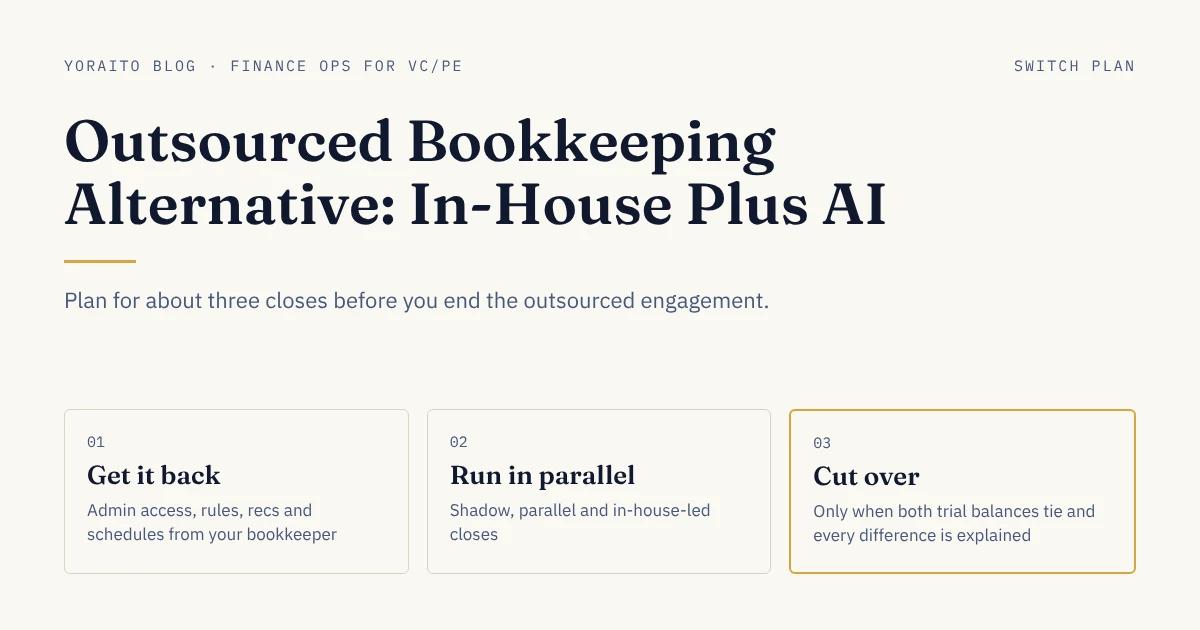
TL;DR: The most common outsourced bookkeeping alternative is a small in-house team that owns the ledger, with AI tools handling repetitive matching and coding under review. Make the switch safely in three steps: get every record and rule back from your bookkeeper, run one or two closes in parallel, and cut over only when the trial balances tie.
What is the alternative to outsourced bookkeeping?
In-house plus AI means your own staff owns the general ledger, and AI does the repetitive work under rules your team can read and a reviewer can sign off.
It sits between two models most founders already know:
- Outsourced bookkeeping: an outside firm keeps your books, usually on a monthly cycle, using its own staff, checklists and rules.
- Fully in-house: you hire enough people to do every task by hand, from bank matching to coding vendor bills.
- In-house plus AI: one or two people own the close and the judgment calls; software proposes matches, codings and drafts; a person approves each one, and the reasoning is stored.
The goal is not fewer people at any cost. It is owning the answers. When an operating partner asks why gross margin moved, the person who closed the books should be down the hall, not in a ticket queue.
When have you outgrown your outsourced bookkeeper?
Outsourcing is often the right call early. Burkland Associates, which sells outsourced accounting, still lists warning signs that a setup is no longer working, including a close that routinely runs past ten calendar days and knowledge held by one person (Burkland, Feb 2026). Those signs apply to any model, including yours.
Check the ones that are true today:
- Reporting cadence has tightened. A board or sponsor now wants a monthly pack within a set number of days, not "when the books are done."
- Simple questions take days. "Why is this vendor in COGS?" goes into a queue.
- You can't see the rules. Bank rules, coding habits and accrual methods live in the bookkeeper's head or their own templates.
- An audit, quality of earnings review or financing is coming. Someone will ask for support you have never seen.
- One person at the firm knows your books. If they leave, so does the context.
- Cleanup happens before every tax season. The year gets fixed in March instead of being right each month.
Three or more checks is a good reason to plan the move. One or two may be fixed by a better engagement letter.
How do outsourced, in-house and in-house plus AI compare?
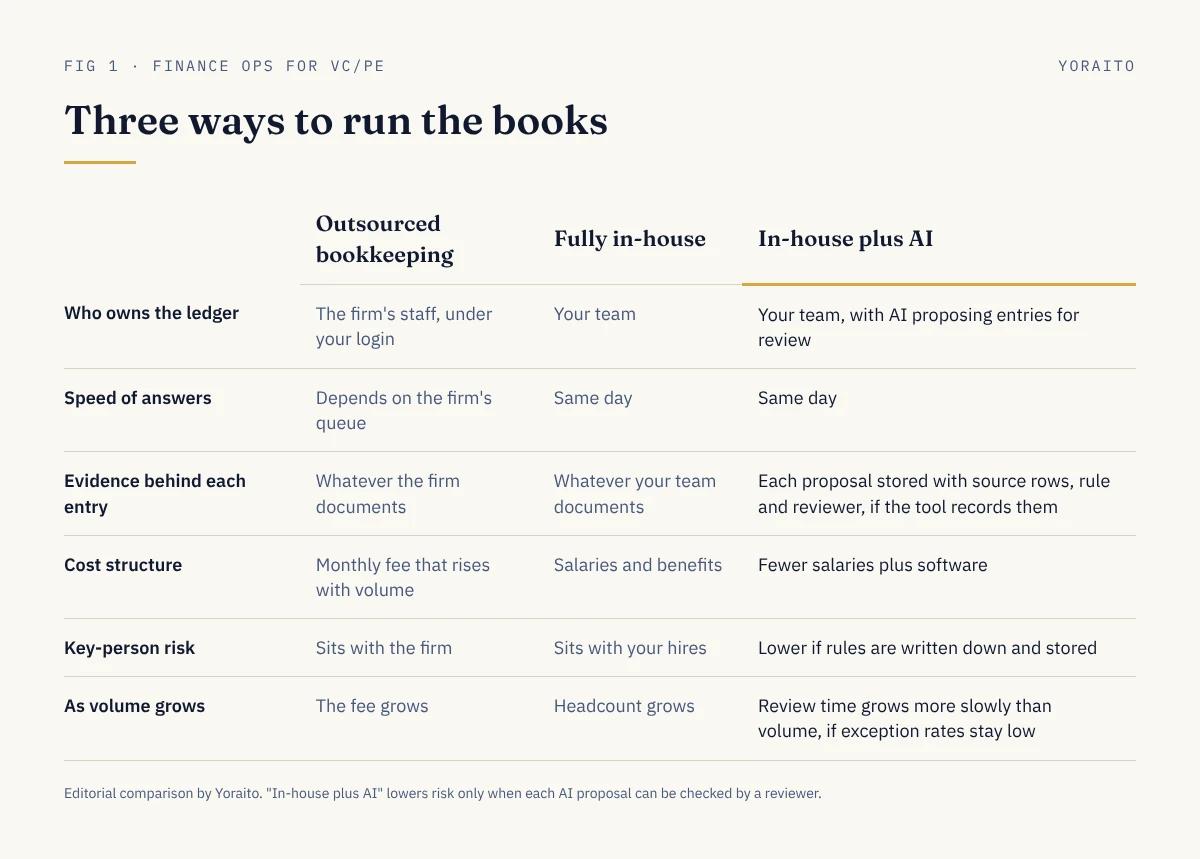
- Who owns the ledger: Outsourced: the firm's staff, under your login; Fully in-house: your team; In-house plus AI: your team, with AI proposing entries for review.
- Speed of answers: Outsourced: depends on the firm's queue; Fully in-house: same day; In-house plus AI: same day.
- Evidence behind each entry: Outsourced: whatever the firm documents; Fully in-house: whatever your team documents; In-house plus AI: each proposal stored with its source rows, rule and reviewer, if the tool records them.
- Cost structure: Outsourced: a monthly fee that rises with volume; Fully in-house: salaries and benefits; In-house plus AI: fewer salaries plus software.
- Key-person risk: Outsourced: sits with the firm; Fully in-house: sits with your hires; In-house plus AI: lower if rules are written down and stored.
- As volume grows: Outsourced: the fee grows; Fully in-house: headcount grows; In-house plus AI: review time grows more slowly than volume, if exception rates stay low.
The "if" in that last column matters. AI only lowers risk when its work can be checked. A tool that codes 2,000 transactions with no record of why has moved the black box from your bookkeeper to your software.
Want every match and coding to come with the source rows, the rule and the reviewer behind it? Join the Yoraito waitlist for early access.
What should you get back from your bookkeeper before you switch?
Ask in writing, early, and before you give notice if your contract allows it. If your bookkeeper is a CPA firm, the AICPA's records-request rule says a member may not withhold client-provided records when responding to a client's initial request, even over unpaid fees (Journal of Accountancy, Mar 2021). Non-CPA bookkeepers are governed by your contract, so read the engagement letter first.
The handover checklist:
- Admin access. You should be the primary admin of your own accounting system. In QuickBooks Online, the accountant starts the transfer from Manage users, and it is not complete until you accept the emailed link (Intuit QuickBooks help).
- A login inventory. Banks, cards, payroll, bill pay, expense tools, and who has access to each.
- Chart of accounts with the reasoning. What each account is for, and any mapping used for the board pack.
- Written bank and coding rules. Every auto-categorization rule, plus the unwritten habits ("SaaS under $500 goes to software expense").
- Reconciliations for every account and month, with the statements that support them.
- Schedules: prepaids, accruals, deferred revenue, fixed assets and depreciation.
- Open items: unpaid bills, open invoices, uncleared checks and any suspense balances.
- Payroll journal mapping and where the payroll reports live.
- Vendor W-9s and 1099 history.
- Tax filings and correspondence for the years still open.
- The close checklist they actually follow, with timing.
Keep it all. The IRS says to keep business records for at least 3 years in most cases, 6 years if income was underreported by more than 25%, and employment tax records for at least 4 years (IRS, How long should I keep records?).
How do you run a parallel close before cutting over?
Plan on roughly a quarter. Month by month:
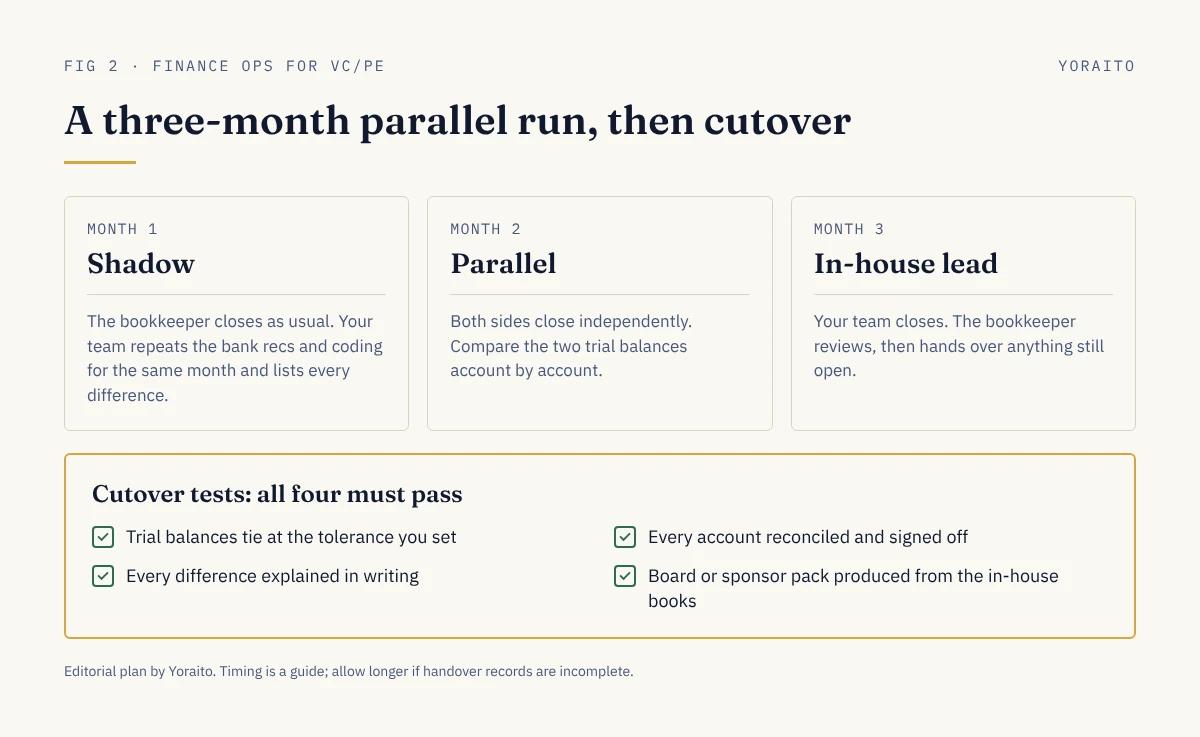
- Month 1, shadow: The bookkeeper closes as usual. Your team repeats the bank recs and coding for the same month and lists every difference.
- Month 2, parallel: Both sides close independently. Compare the two trial balances account by account.
- Month 3, in-house lead: Your team closes. The bookkeeper reviews, then hands over anything still open.
- Cutover tests: trial balances tie at the tolerance you set; every account reconciled and signed off; every difference explained in writing; the board or sponsor pack produced from the in-house books.
The trial balance comparison is one query if you export both sides to a table. An illustrative version:
-- Compare the bookkeeper's TB with the in-house TB for one period
SELECT COALESCE(o.account_no, i.account_no) AS account_no,
       COALESCE(o.balance, 0) AS outsourced_tb,
       COALESCE(i.balance, 0) AS inhouse_tb,
       COALESCE(i.balance, 0) - COALESCE(o.balance, 0) AS difference
FROM tb_outsourced o
FULL OUTER JOIN tb_inhouse i
  ON i.account_no = o.account_no AND i.period = o.period
WHERE COALESCE(o.period, i.period) = '2026-09'
  AND ABS(COALESCE(i.balance, 0) - COALESCE(o.balance, 0)) > 0.00
ORDER BY ABS(COALESCE(i.balance, 0) - COALESCE(o.balance, 0)) DESC;
Every row this returns needs a one-line reason. Most will be timing or a coding habit nobody wrote down. Those reasons become rules for month 3.
If you plan to add AI tools during the switch, run them as part of month 2 and score them. Our 30-day AI accounting pilot scorecard gives you the measures: accuracy, exception rate, reviewer time and audit trail.
Where should AI fit in the new setup, and where shouldn't it?
AI works well on high-volume, rule-shaped tasks: matching bank lines, suggesting account codes, reading invoices and drafting first-pass variance notes. It should not decide accrual estimates, revenue recognition judgments or anything that needs approval authority.
Whatever it does, each proposal should record its input, the rule or logic used, the version, the reviewer and the time. Our AI audit trail checklist lists the fields, and our post on how AI bank reconciliation matches should be explained shows what a reviewer should see for each match.
Plan for review, too. A two-person team has fewer ways to split duties than an outside firm with its own reviewers. The ACFE's 2024 Report to the Nations found that a lack of internal controls was the most cited weakness, in 32% of fraud cases, and that organizations with fewer than 100 employees had a median loss of $141,000 (ACFE 2024 report, PDF). Simple fixes help: the person who approves an AI proposal is not the person who pays the vendor, and the controller or CFO reviews every manual journal.
What will your auditor or sponsor want to see after the switch?
A short cutover memo, kept with the year's support:
- The date the in-house team took over, and who closed each month during the parallel run.
- The trial balance comparison for the parallel months, with every difference explained.
- The records received from the bookkeeper, against the checklist above.
- Any rules changed at cutover and why.
- Who reviews what now, by role.
At year end, this memo sits next to the reconciliations on your PBC list. If you report to a PE sponsor, flag the change in the next monthly reporting pack so a change in process isn't mistaken for a change in the numbers.
FAQ
What is the best alternative to outsourced bookkeeping?
For a growing company with board or sponsor reporting, the common alternative is a small in-house team that owns the ledger, often supported by AI tools for matching and coding. A fractional controller who reviews in-house work is another option if you are not ready for a full hire.
How long does it take to bring bookkeeping in-house?
Plan for about three closes: one shadow month, one parallel month and one month where your team leads and the bookkeeper reviews. It can run longer if the handover records are incomplete or past months need cleanup.
Can my bookkeeper keep my records if I leave?
If they are an AICPA member, they may not withhold client-provided records on your first request, even if fees are unpaid. For non-CPA bookkeepers, your engagement letter decides. Either way, make sure you are the primary admin of your accounting system before you give notice.
Should I hire a bookkeeper or a controller first?
It depends on what you are missing. If the problem is volume, a bookkeeper or AI tools may be enough. If the problem is judgment, review and reporting, start with a controller or a fractional controller who can own the close.
What should you do this week?
Send your bookkeeper a written request for the handover checklist above, starting with primary admin access and the written bank and coding rules. What comes back, and how fast, will tell you how hard the switch will be.
To hear when Yoraito opens up, join the waitlist.